

By Andi Misbahul Pratiwi, University of Leeds
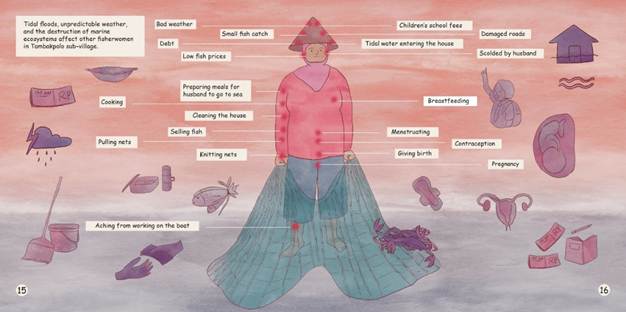
For coastal women and fisherwomen living with chronic tidal flooding, climate change is not only experienced through rising water, damaged livelihoods, displacement, and/or environmental loss. It is also felt through physical pain, emotional stress, reproductive experiences, care work, and the everyday labour of keeping families and communities going. Yet these embodied experiences can be difficult to capture through technical climate research and are often overlooked in climate discourse.
My recent paper, Body Mapping with Care: Decolonising Climate Change Research with Fisherwomen in Indonesia, explores body mapping as a feminist and decolonial participatory method for bringing bodily experiences into climate research. Drawing on fieldwork with fisherwomen and coastal women across tidal flood-affected villages in Demak, Central Java, Indonesia, I examine how women used drawing, storytelling, and collective reflection and action to make climate impacts visible.
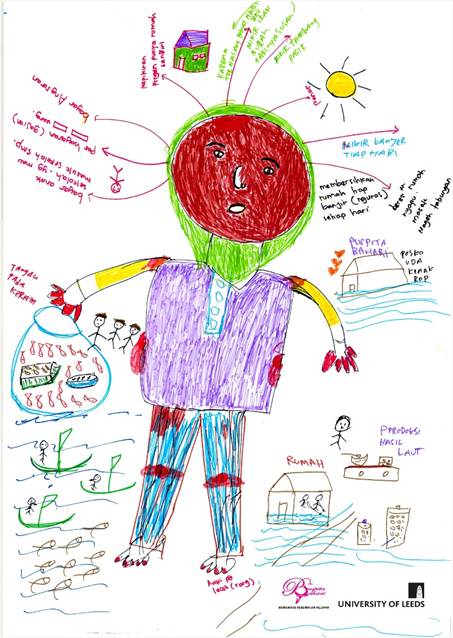
I show how body mapping becomes meaningful and politically powerful when practised through an ethics of care. This means going beyond simply asking participants to draw their bodies. It involves reflecting on the researcher’s positionality, co-designing a research plan, taking ethics and safety in situated ways, responding to different forms of participation, ensuring that knowledge(s) are co-produced, and bringing that knowledge(s) into praxis.
Starting with positionality
Knowledge(s) are never produced from a neutral or detached position. As researchers, we bring our own histories, identities, relationships, and institutional positions into the field.
I entered this research as an Indonesian, a native Indonesian speaker, and a scholar-activist who had worked with Puspita Bahari, a fisherwomen’s movement in Demak. These relationships created a degree of familiarity and trust with fisherwomen in Demak. At the same time, I was also an urban, middle-class researcher and PhD student shaped by both Indonesian and Western academic institutions.
Rather than trying to remove these positionalities and trap myself in an “insider” and “outsider” dichotomy, I treated positionality as dynamic and in need of reflection. Throughout the research, I asked: whose voices are being heard? How do power relations shape the research? And how does my own position influence what becomes visible?
Co-designing the research
Care also meant involving participants in decisions about how the research should happen.
Before the body mapping workshops, coastal women and fisherwomen, members of Puspita Bahari, joined an initial discussion about the research aims and body mapping activities.
Their voices changed the research design. What was initially planned as a workshop in one village became a process across three villages affected by chronic tidal flooding (Morodemak, Purworejo, and Timbulsloko). They also suggested conducting body mapping collectively rather than individually, so that women could support and learn from one another.
We also discussed ownership and copyright of the body maps. These were not simply research materials produced for me as the researcher; they were women’s creative work and could also become resources for their own organising and climate advocacy.
This process reminded me that co-design is not just about asking participants for feedback. It is about allowing their knowledge(s) and priorities to shape the research itself.
Ethics, risk and safety
Before each workshop, I discussed the research aims, consent, data use, copyright, and safety with participants. Participation was voluntary, and consent could be given either orally or in writing, recognising that not everyone was comfortable signing documents.
Safety also had to respond to the realities of coastal life. Workshops were scheduled flexibly around tidal flooding and held in spaces chosen by participants. Women could take breaks whenever they needed, use Indonesian or Javanese (local language), and contribute through drawing, writing, or speaking, depending on their comfort.
Care also meant recognising participants’ everyday responsibilities. Children could attend the workshops, and participants were not expected to share experiences that might compromise their safety or well-being.
These practices show why ethics cannot simply be reduced to institutional forms and procedures. In the field, ethical practice is relational, situated, and responsive.
Doing body mapping together
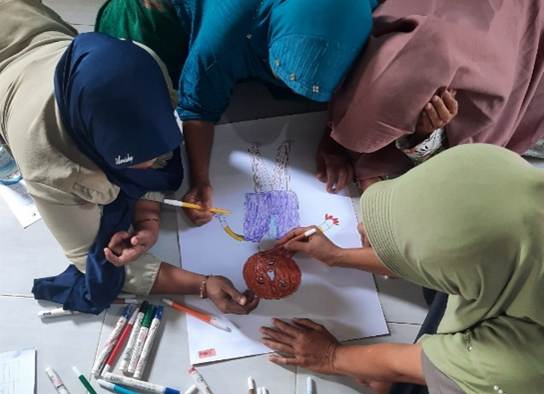
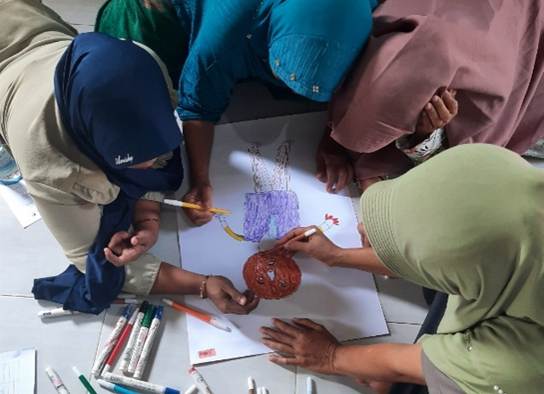
The workshops brought participants together in small groups of around five. Using large sheets of paper and coloured markers, they were invited to draw their bodies and everyday activities and to explore how tidal flooding affected their physical, reproductive, and emotional experiences. They could use colours, symbols, and words to mark pain, emotional strain, joy, strength, and support.
The drawing itself took around 45-60 minutes. It was followed by a collective sharing session, where each group presented its body map and explained what they had represented and what was difficult to represent through drawing alone.
This was an important part of the process. Participants were not simply producing images for the researcher to analyse. They were the storytellers and meaning makers of their own maps.
Making space for different emotions and voices
The workshops did not produce one predictable emotional response. There were moments of sadness and tears, but also laughter, humour, and enjoyment.
For example, one participant became emotional while recalling the loss of fishing nets during a storm and the difficulties caused by tidal flooding. In other cases, participants described enjoying the drawing process, with some noting that they had not drawn for many years. Even when discussing difficult experiences, humour often became part of how women narrated everyday life with flooding.
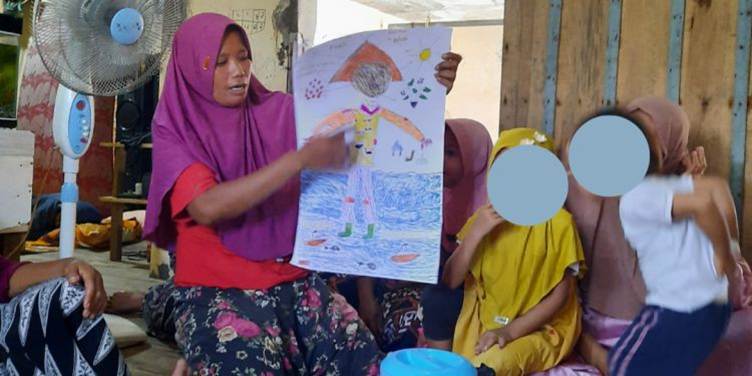
Participation was also uneven. Some women were more vocal, while others remained quiet or hesitant. Rather than interpreting silence as disengagement, I treated it as a different form of emotion and a reminder of the limitations of group body mapping as a method that cannot stand alone.
Follow-up interviews provided another space for women to share experiences that were difficult to discuss in a group. The body maps became prompts for these conversations, helping to open deeper discussions about embodied experiences.
From body maps to collective actions
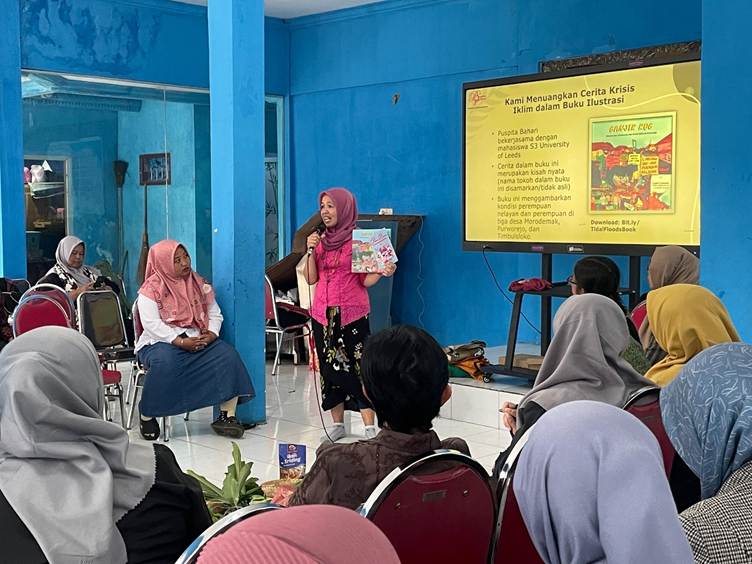
Beyond my PhD project, the artworks were also used to strengthen the fisherwomen’s movement on climate action.
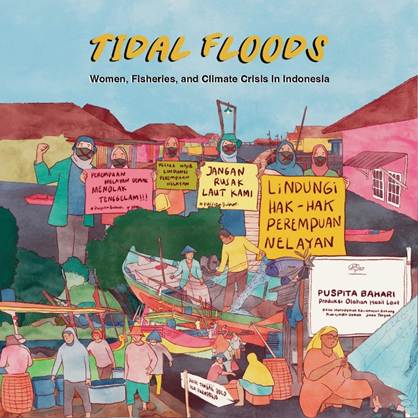
Together, we co-created a collective action that manifested in the form of an illustrated book, Banjir Rob: Perempuan, Perikanan, dan Krisis Iklim di Indonesia (Tidal Floods: Women, Fisheries, and the Climate Crisis in Indonesia), published in Indonesian and English. The book has helped communicate and advocate for their experiences of the climate crisis to broader audiences. In the book, the body map artworks are transformed into collective stories.
What does body mapping offer?
Body mapping can make visible forms of knowledge(s) that are often missing from climate research. But body mapping is not automatically participatory, feminist, and/or decolonial. How the method is practised matters.
Body mapping needs care. This is where it becomes a feminist and decolonial methodology that can drive praxis: a way of producing situated and embodied knowledge(s) while potentially creating space to strengthen solidarity and collective action.
The full open-access article, published in AREA, develops these arguments in detail and can be read here: https://rgs-ibg.onlinelibrary.wiley.com/doi/pdf/10.1111/area.70144.
About the author: Andi Misbahul Pratiwi is an Indonesian scholar-activist and PhD candidate at the School of Geography, University of Leeds, UK. She is also a research fellow at the Gender Research Centre, Universitas Indonesia. Her research explores intersectional climate justice in coastal Indonesia, with a focus on embodied knowledges, gendered vulnerabilities, intersectional inequalities, everyday adaptation strategies, and feminist solidarities among coastal women and fisherwomen.
Suggested further reading
Aroussi, S., Badurdeen, F. A., Verhoest, X., & Jakala, M. (2023). Seeing bodies in social sciences research: Body mapping and violent extremism in Kenya. Qualitative Research. Available from: https://doi.org/10.1177/14687941221096598
Baker, G. (2025) Questions of power and ethics: Doing feminist research in methodological contexts that let the body lead. Area. Available from: https://doi.org/10.1111/area.70030
Dos Ventos Lopes Heimer, R. (2021). Travelling Cuerpo-Territorios: A decolonial feminist geographical methodology to conduct research with migrant women. Third World Thematics: A TWQ Journal. Available from: https://doi.org/10.1080/23802014.2022.2108130
Luckett, T., & Bagelman, J. (2023). Body mapping: feminist-activist geographies in practice. Cultural Geographies. Available from: https://doi.org/10.1177/14744740231179479
Pratiwi, A.M. (2026), Body Mapping With Care: Decolonising Climate Change Research With Fisherwomen in Coastal Indonesia. Area. Available from: https://doi.org/10.1111/area.70144
How to cite
Pratiwi, A. M. (2026, September) What can women’s bodies tell us about climate change? Geography Directions. https://doi.org/10.55203/FNMA8485

