

By the States of Precarity Team: James Esson, Johanne Bruun, Rachel Colls, Peter Forman, Anna Jackman, Jasmine Joanes & Rachael Squire
Finding and starting an academic job involves navigating a host of processes that are not always transparent to those encountering them, especially for the first time. Where should you look to find opportunities? What can you ask about when negotiating a job offer? What should you expect from an induction? Who can you turn to if difficulties arise? Much of this knowledge is acquired through a mixture of formal and informal channels. For example, conversations with PhD supervisors, post-doc line managers, mentors, colleagues and friends, as well as guidance provided by departments, professional bodies, learned societies and trade unions. The extent to which people can access and benefit from these forms of guidance and support is uneven and shaped by structural factors such as racism, ableism, transphobia, restrictive visa regimes and the uneven recognition of caring responsibilities.
A new toolkit from the States of Precarity project brings together practical, experience-based guidance for PhD researchers and early-career academics navigating job searches and securing employment in UK higher education. Developed from a discipline-wide survey and engagement with Geographers across career stages, the toolkit makes visible and accessible knowledge and support that often circulate informally.
Access to knowledge and support matters
The challenges faced by early career geographers in the UK are particularly acute at the moment. Jenny Pickerill’s recent State of Geography in UK Higher Education report found that 61% of geography departments had experienced a reduction in academic staff numbers in the previous 12 months. These reductions reflected a range of reasons – from posts not being replaced, voluntary redundancy, threats of compulsory redundancy, retirement, to job moves and more staff moving to part-time roles. As the report highlights, these pressures are also uneven, with smaller and medium-sized institutions often particularly and disproportionately affected.
At the same time, job opportunities have not completely disappeared. 41% of departments reported recruiting new geography staff on open-ended contracts during the same period, although this recruitment was itself uneven across institutions and regions. As opportunities become more constrained, the inequalities in access to knowledge, networks and support identified above risk becoming at once increasingly embedded and consequential for how colleagues navigate academic careers.
It is within this context that we have developed Navigating States of Precarity: A Toolkit for Early Career Academics. The toolkit grows out of our wider States of Precarity project, which included a discipline-wide survey of 364 respondents, from PhD students through to professors, as well as focus groups with academic geographers across different career stages and contractual terms.
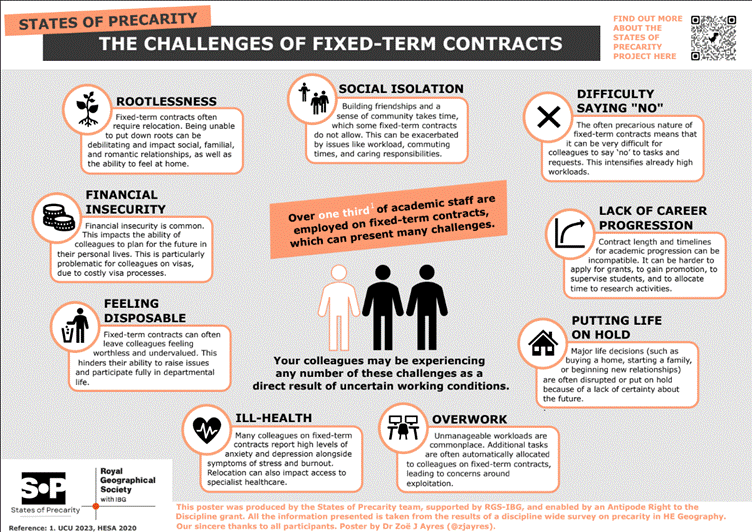
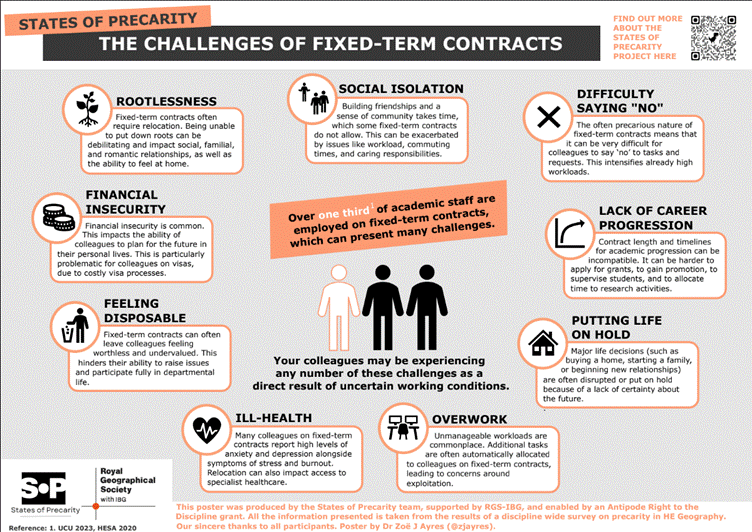
Alongside rich insights on the wide-ranging professional and personal effects of precarious employment, a clear message from research participants was the need for and value of practical guidance. One response to this was the development of a series of practical resources aimed at raising awareness and supporting change across the discipline. Alongside an overview report, these included both awareness-raising posters, designed by Zoë Ayres, intended for display and promoting discussion within geography departments, as well as a series of Best Practice Action Plans to help departments, managers and colleagues identify practical interventions that could improve the experiences of those on fixed-term contracts. The Action Plans span relatively immediate changes, such as improving communication and inclusion, to more longer-term strategic interventions around access to institutional resources and opportunities.
Collectively, these resources are focused on raising awareness and supporting change at and across departmental and institutional levels. However, PhD researchers and early career colleagues, particularly those who had experienced fixed-term employment, communicated to us the desire and need for something more directly focused on the kinds of questions and decisions that arise during and across the employment journey, from applying for jobs and negotiating contracts, to starting a new role, dealing with workplace difficulties and eventually leaving a post.
From documenting precarity to navigating it
The Navigating States of Precarity toolkit is designed to be used flexibly. It is organised around six sections that follow different stages or challenges associated with academic employment:
- Applying for jobs, with guidance on academic and non-academic options, finding opportunities, and getting feedback on applications.
- Preparing for a new role, from contract negotiations and relocation to planning your departure from a current post.
- Starting a new job, with advice on line management, induction, building relationships and union membership.
- Leaving a job, including how to manage the loss of access to university resources, maintain professional connections and plan next steps.
- Navigating workplace difficulties, with guidance on where to seek advice and how to protect mental health and wellbeing.
- Useful resources, bringing together quick-reference information on employment rights and trade union support, alongside guidance on careers, housing, finances and wellbeing.
Readers can work through the toolkit from beginning to end or dip into individual sections when questions arise. The emphasis throughout is on contextual guidance rather than prescribing a single route through academic employment processes. Accordingly, the toolkit includes prompts, suggestions and points of reference that colleagues can draw on according to their circumstances, recognising that what is possible or useful will vary from person to person.
You can access the toolkit here.
A community resource, not a finished answer
While the toolkit was curated by the States of Precarity project team, as above, it emerged from a discipline-wide survey and wider engagement with colleagues across UK Higher Education Geography. We therefore see it as an evolving, periodically-updated, community resource rather than a finished product. Given that one of its purposes is to make knowledge that often circulates informally through personal networks more visible and shareable, we invite colleagues to contribute their own experiences, suggestions and resources. You can do this through the feedback link on the toolkit webpage. In doing so, we hope the toolkit can continue to develop and reflect the different ways precarity emerges and is encountered across the discipline.
This research was funded by a Royal Geographical Society and Antipode Right to the Discipline grant.
Further suggested reading
Mason, O. (2026). Doing Geography Amidst Precarity. Area. Available from: https://doi.org/10.1111/area.70109
Pickerill, J. (2026). The State of Geography in UK Higher Education. Available from: https://www.rgs.org/media/qhpipvi3/the-state-of-geography-in-uk-higher-education.pdf
Squire, R., Esson J., Bruun, J., Colls, R., Forman, P., Jackman, A., Joanes, J. (2025). States of Precarity in UK HE Geography. Available from: doi.org/10.55203/LUKX8379
How to cite
Esson, J., Bruun, J., Colls, R., Forman, P., Jackman, A., Joanes, J., Squire, R. (2026, October). Navigating states of precarity: A new toolkit for early career academics. Geography Directions. https://doi.org/10.55203/MIIA1879

