


By Wenwan Jin, Yuxin Zhu, Xiongbin Lin and Xingchuan Gao, Ningbo University
When the US-China trade war escalated in 2018, agriculture was among the sectors that experienced significant disruption. Tariffs imposed on both sides affected a wide range of agricultural commodities, such as soybeans and meat products. Bilateral agricultural trade fell by 29 per cent between 2017 and 2019, from 34.9 billion to 24.8 billion. For soybeans alone, trade dropped by nearly 43 per cent, from 14 billion to 8 billion over the same period. For an economy deeply integrated into global value chains, this represented a real-time stress test of trade resilience.
But not all regions or products suffered equally. Some Chinese provinces recovered quickly, while others struggled. From a geographical perspective, this spatial variation is not random but reflects deep-rooted differences in location, infrastructure, and regional economic structures. What explained the difference? Our new research, published in The Geographical Journal, uses customs data from 2019 to 2022 to identify the strategies that helped China’s agricultural trade weather the storm. The answer lies in two forms of diversification. Geographical diversification means trading with a wider range of countries, so that a tariff in one market does not cut off supply entirely. Product diversification means trading a wider variety of agricultural goods, so that a shock to one commodity does not bring down the whole trade portfolio. More surprisingly, whether those relationships are weak or strong matters just as much as the number.
A framework for understanding trade resilience
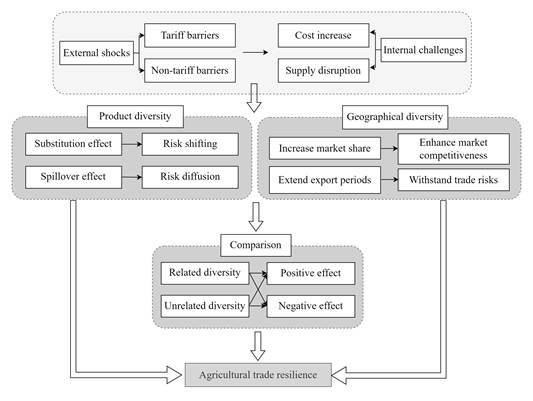
We developed a conceptual framework to understand how diversification builds resilience during a trade war, as shown in Figure 1. The concept of regional economic resilience that underpins our framework was originally developed by economic geographer Ron Martin to explain why some regions withstand shocks better than others. The logic of our framework is intuitive. When tariffs cut off access to a key supplier, you can either find a new country to buy from, which is geographical diversification, or shift to a different product altogether, which is product diversification. Product diversification mitigates shocks through substitution and spillover effects, while geographical diversification stabilises trade by expanding market access and extending export cycles.
Where resilience varied: Regional and sectoral patterns
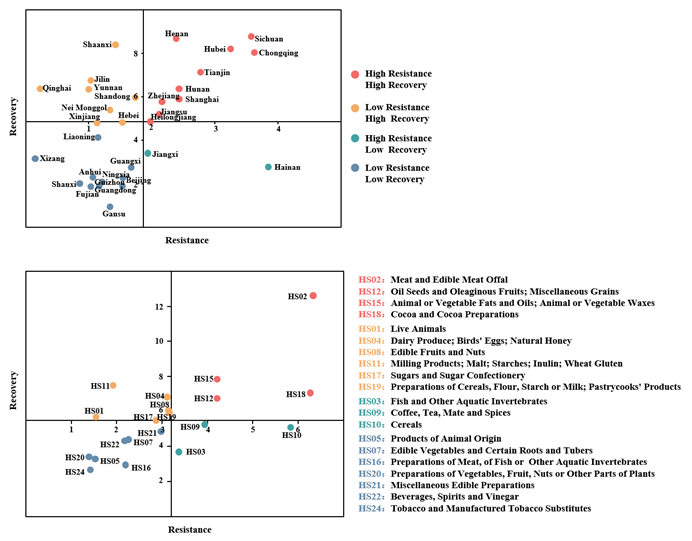
Figure 2 illustrates two important dimensions of this variation. In terms of regions, Sichuan and Chongqing exhibited the highest resilience, followed closely by coastal provinces such as Jiangsu and Zhejiang and major agricultural provinces including Henan and Hubei. The eastern region, with its proximity to ports, extensive industrial chains and flexible markets, was best positioned to leverage diversification benefits. Central and western regions, constrained by underdeveloped infrastructure and limited geographical advantages, saw weaker effects. This east-west divide is a classic geographical pattern: regions that are better connected and closer to markets adapt faster, while more remote regions struggle, regardless of their other endowments.
In terms of sectors, we used the Harmonised System (HS) of commodity classification to identify product categories. Meat products (HS02) showed the strongest resilience, supported by high demand and diverse international suppliers including Brazil, Australia and the United States. Oilseeds (HS15) and feed products (HS12) remained relatively resilient due to limited substitutes. In contrast, fruit and vegetable products (HS20), tobacco (HS24) and animal products (HS05) were more severely affected.
Two strategies, two time horizons
Our empirical analysis confirms that both geographical and product diversification work, but they operate on different timescales.
Geographical diversification proved critical in the immediate aftermath of the trade war. In 2019, its positive impact on trade resilience was nearly twice as strong as product diversification. Provinces that already traded with a wide range of partners, such as Brazil, Thailand or Vietnam, could quickly reroute supply when US goods became prohibitively expensive.
Product diversification became the dominant driver of resilience over the longer term. By 2022, its influence had surpassed that of geographical diversification. The reason is that expanding the range of agricultural products a region produces builds internally generated capacity. It reduces dependence on any single commodity, creates internal buffers against volatility, and enables structural transformation toward higher-value goods.
The counter-intuitive finding: Weak links are strong for products, not for partners
Our most novel contribution goes beyond measuring diversity to unpacking its internal structure. Drawing on foundational work on related and unrelated variety in regional economies, which distinguishes between activities that are closely interconnected versus those that are not, we classified diversification into two types. Related diversification refers to situations where products or trading partners are closely interconnected, meaning that a change in one tends to affect the others. Unrelated diversification refers to situations where products or partners have weak or no connections, so that a shock to one does not easily spread to others.
For product diversification, unrelated variety drives resilience. When products have weak links to each other, a shock to one does not cascade to others. Unrelated products act as shock absorbers, confining disruption to isolated sectors. Product-related diversification, by contrast, had a significantly negative effect. Tight interconnections allowed the trade war’s impact to spread from soybeans to soybean oil, canola meal and beyond.
For geographical diversification, related variety drives resilience. Trading with partners that are economically interconnected, for example China, Brazil and Argentina in the soybean market, enabled rapid trade reallocation. When US supplies were disrupted, Brazilian and Argentinian producers could step in seamlessly. Geographically unrelated diversification, characterised by sparse trade links with no synergy, had no measurable positive effect.
What does this mean for understanding trade resilience? Resilience is not a passive quality. It is built through deliberate strategy. The US-China trade war showed that agricultural trade can survive severe disruptions, but survival depends on what you trade, who you trade with, and how the relationships among them are structured. For products, weak links build strength. For partners, strong links do.
About the authors
Wenwan Jin is a specially appointed Associate Researcher in the Department of Geography and Spatial Information Technology at Ningbo University, China. Her overall research interests are regional industrial dynamics, innovation development, and talent mobility. (Corresponding author: jinwenwan@nbu.edu.cn)
Yuxin Zhu is a Master’s student in the Department of Geography and Spatial Information Technology at Ningbo University, China. Her overall research interest is agricultural trade.
Xiongbin Lin is a Professor in the Department of Geography and Spatial Information Technology at Ningbo University, China. His work focuses on transport geography and urban-rural development. (Corresponding author: xiongbinlin@126.com)
Xingchuan Gao is an Associate Professor in the Department of Geography and Spatial Information Technology at Ningbo University, China. His research interests include smart transportation and regional development.
Suggested further reading
Evenhuis, E (2017) New directions in researching regional economic resilience and adaptation. Geography Compass. Available from: https://doi.org/10.1111/gec3.12333
Frenken, K, Van Oort, F and Verburg, T (2007) Related variety, unrelated variety and regional economic growth. Regional Studies. Available from: https://doi.org/10.1080/00343400601120296
Jin, W, Zhu, Y, Lin, X and Gao, X (2026) Resilience of agricultural trade during the US-China Trade War: The role of product and geographical diversification. The Geographical Journal. Available from: https://doi.org/10.1111/geoj.70084
Martin, R (2011) Regional economic resilience, hysteresis, and recessionary shocks. Journal of Economic Geography. Available from: https://doi.org/10.1093/jeg/lbr019
Önder, A S and Yilmazkuday, H (2016) Trade partner diversification and growth: How trade links matter. Journal of Macroeconomics. Available from: https://doi.org/10.1016/j.jmacro.2016.10.003
How to cite
Jin, W., Zhu, W., Lin, X. and Gao, X. (2026, June) When tariffs hit: How China’s agricultural trade weathered the storm. Geography Directions. https://doi.org/10.55203/IMRV9573

