

By Francisco Llinás Casas, University of Edinburgh, and Erick Moreno Superlano, University of Oxford
Maduro’s capture underscores the inadequacy of outdated ideological frameworks and exposes a bitter reality: in the face of the ineffectiveness of global institutions, political change in Venezuela has ultimately come to depend on the force and strategic interests of superpowers.
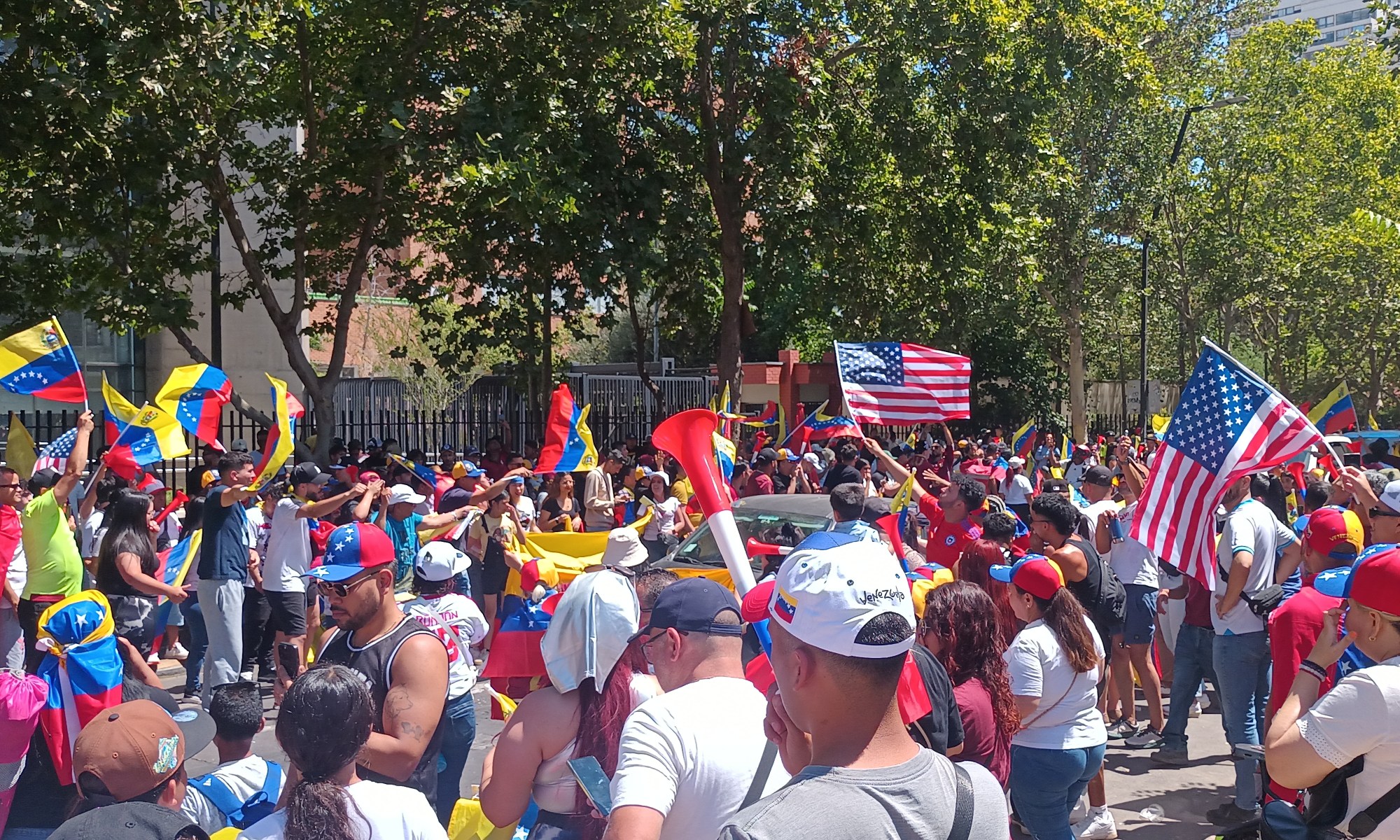
In front of the Brooklyn courthouse where Nicolás Maduro was to be charged on the 5th of January, anti-Trump protestors, holding banners that read “hands off Venezuela” and “free Maduro,” clashed against a group of Venezuelan migrants celebrating the capture of the dictator. Both groups were waving Venezuelan flags, though for opposing reasons. These kinds of protests have become commonplace in many cities of the world over the last few days. In the UK, for example, Jeremy Corbyn has repeatedly delivered speeches next to Venezuelan flags condemning US’s actions – including a recent online event with the regime’s ambassador to the UK, Felix Plasencia, advocating for Maduro’s release. Equally ubiquitous on digital media are videos of Venezuelans around the globe approaching the pro-Maduro lines, trying to find a co-national among them but unable to do so. Many Venezuelans feel frustration at the sight of anti-imperialist demonstrations, where their national flag is waved against Trump but Venezuelans’ opinions are unheard. While those like Corbyn see US recent actions as a violation of international law, for Venezuelans, international legislation has failed to support their fight for democratic change under authoritarian rule. This confrontation between Venezuelans and anti-interventionist protestors requires from us to complexify ideas around self-determination, and the adequacy of invoking international law and anti-imperialism as a way of protecting sovereignty.
Since January 2024, we have been conducting research on Venezuelan migration in the US, particularly in New York and Florida. Since the strikes on Saturday 3rd, we have been talking to our interlocutors as well as people in Venezuela about what is going on in the country. Venezuelans across the globe had taken to the streets to show their cautious hope in the face of Maduro’s arrest. However, in Venezuela, the regime continues to exist with its mechanisms for social repression. Fear of expressing any form of celebration inside the country is strong, as it might lead to charges of treason. “We are happy, of course, but colectivos [armed militias] and SEBIN [the regime’s intelligence agency] are out,” one of our interlocutors in Venezuela told us. “I don’t even dare to hang a flag outside my window.”
Fear in Venezuela has steadily intensified after Maduro’s electoral fraud in July 2024. In an unprecedented demonstration of civil organisation led by Maria Corina Machado, the opposition published proof of their victory. The fraud violated Venezuelan’s right to self-determination, upon which article 5 of the constitution ultimately rests the nation’s sovereignty. Maduro declared Machado and her running mate, Edmundo Gonzalez, national enemies and intensified terror tactics, imposing what could be seen as an indefinite state of exception. While news of the electoral fraud quickly reached international media, and some global leaders and organisations, including the UK Foreign Office, demanded the publication of tallies by Venezuela’s electoral commission, little else happened. For Maduro, it was business as usual, often appearing on national television dancing salsa with his wife.
The lack of decisive response from global leaders and institutions such as the Organisation of American States (OAS), the United Nations (UN), and the European Union (EU) to the fraud prolonged in Venezuela a situation of political irresolution. Such actors limited themselves to expressing their concerns and calling for dialogue between the government and the opposition. However, the multiple attempts to establish dialogue, including those mediated by Norway, had proven fruitless, because the regime was unwilling to meet the opposition’s two fundamental requests: the immediate release of political prisoners and free elections. Venezuelans felt frustrated in the light of the international community’s inability to support democracy in Venezuela. ‘We’ve tried everything,’ many of our interlocutors conclude.
In October 2025, the Norwegian Nobel Committee, fully aware of the dictatorship’s vile instrumentalization of dialogue attempts, awarded Machado the Nobel Peace Price. Her recent presentation of the award to Trump constitutes a gesture of support and approval for the United States’ military movement against the dictatorship. The Venezuelans we spoke with perceive Trump’s actions as the first tangible steps toward democracy and therefore deserving of Machado’s recent visit. The interviewees feel that Venezuela had little choice but to endorse Trump’s expansionist and commercial interests, as these happen to align with their main goal: a change of regime.
As Venezuelan sociologist Rafael Uzcátegui writes, Venezuelans’ political reality cannot be understood in the dualistic light of imperialism vs. self-determination that likens politics to a black and white game of chess. Instead, it is more like a game of poker, in which the best hand may not always be the one to win. With the support of the Venezuelan people, Machado is playing her best hand, which involves endorsing Trump’s expansionist and commercial interests in exchange for military support. Disproportionately benefiting Russian and Chinese interests, and the American Chevron, who still operates in Venezuela, the national oil company PDVSA, is currently of little benefit to the Venezuelan people. The now-crumbling oil industry has long been a platform for ideological and personalistic interests, as best-demonstrated by Chavez’s mass layoff of 1800 oil workers on live television in 2002. As Venezuelans see it, Trump’s thirst for oil at least helps their democratic cause. So, rather than imperialism, Trump’s commercial ambitions are seen by Venezuelans as an avenue for change. Pedro, a Venezuelan business owner in Doral, Florida, told us: ‘If the price for my country to be safe and have food is to give away our oil, so be it. Please, Mr Trump, come and take our oil’.
For Venezuelans like Pedro, who are aware of the regime’s political brutality, the image of cuffed and blindfolded Maduro has a taste of justice. Even Amanda, a Venezuelan student in New York who supported Chávez for many years and who disagrees with the way Maduro was arrested, admits to feeling satisfaction of finally seeing justice being served. ‘Though I technically agree with protests against interventionism’, she said, ‘I think they are disrespectful toward the opinions of Venezuelans’. To release Maduro on the basis of international law and imperial interventionism would feel for Pedro and Amanda as contravening their determination for a democratic future. For other migrants in New York, like Eddy, who works as a photographer, the dictator’s release would even compromise a future in which he can be reunited with his three children who he left in Venezuela.
Emotions are running so high that, during the protests outside the Brooklyn courthouse, Andrés, the founder of an NGO that supports low-income migrants, saw a fellow Venezuelan snatch a flag from the hands of an American protester. ‘For Venezuelans, Americans supporting Maduro are deeply enraging, and suspect that they are paid by his regime’. They think this because ‘Venezuelans cannot understand how anyone could voluntarily support Maduro’ and because, for the longest time, paying their supporters was one of the regime’s tactics to manufacture legitimacy. ‘Far left and far right are equally bad’, Andrés told us, ‘but I am afraid of the violence these confrontations may cause’.
Venezuela’s situation demonstrates the obsolescence of cold-war-time, anti-imperialist ideas that see US actions in Venezuela as an unilateral imposition of its agenda. Maduro’s Vice President, Delcy Rodriguez, has not only agreed to satisfy all of Trump’s oil-related demands, but everything indicates that she might have been the one who facilitated Maduro’s capture in exchange of power. Simultaneously, as we have discussed above, Machado has also been instrumental in leveraging Trump’s geopolitical agenda for the benefit of Venezuela’s future. Disregarding the pivotal role that Venezuelan political actors like Rodriguez and Machado have played in the recent events, anti-imperialist protestors calling for ‘hands-off Venezuela’ disclose their limited knowledge of Venezuela’s complex affairs and the inadequacy of their anti-imperialist rhetoric.
Politicians like Corbyn condemning US actions in Venezuela indirectly align themselves with the dictatorship, compromising the credibility of their democratic values, and ignoring how anti-imperialist rhetoric can also be an alibi for tyranny. Tragically, the US military violence denounced by Corbyn has achieved more in a few days than what democratic international institutions attained in Venezuela over the last decade. On 8th January, Delcy Rodriguez started releasing political prisoners, catering to Trump’s pressure. The fact that political change could only be attained by violence, further erodes a global culture of democracy and trust in international law. The gruesome lesson that some Venezuelans – and other oppressed populations like those of Iran and Cuba – may take away from Maduro’s capture is that democratic means are insufficient to attain political change, and that the force and commercial expansion of military super powers always prevails.
About the authors: Francisco Llinás Casas is a doctoral researcher on Latin American Studies at the University of Edinburgh. His work examines Venezuela’s migration crisis, and their associated social and spatial conflicts. Erick Moreno Superlano is a doctoral candidate at the University of Oxford. His research lies at the intersection of human geography, migration studies, and social theory.
Suggested further reading
Antillano, A, E. Desmond Arias, and V. Zubillaga. (2020) “Violence and Territorial Order in Caracas, Venezuela.” Political Geography. Available from: https://doi.org/10.1016/j.polgeo.2020.102221
Neuman, W. (2022) Things Are Never so Bad That They Can’t Get Worse: Inside the Collapse of Venezuela. New York: St. Martin’s Press.
Strønen, I. Å. (2017) Grassroots Politics and Oil Culture in Venezuela : The Revolutionary Petro-State. Cham: Springer International Publishing. Available from: https://doi.org/10.1007/978-3-319-59507-8
How to cite
Llinás Casas, F. and Moreno Superlano, E. (2026, January) Venezuelans celebrating Maduro’s capture reveals the inadequacy of anti-imperialist rhetoric. Geography Directions. https://doi.org/10.55203/POSX3518
 Geography Directions