


By Lauren Wagner, Maastricht University
At a long overdue lunch the other day, my friend Gili and I got to talking about coding and analysis. We are both on the same page: frustrated with the lack of guidance, in textbooks and the like, for how qualitative analysis actually works.
Turns out that she, like many of us who train students in qualitative methods, had made her own 2-page guide for how to do ‘analysis’.
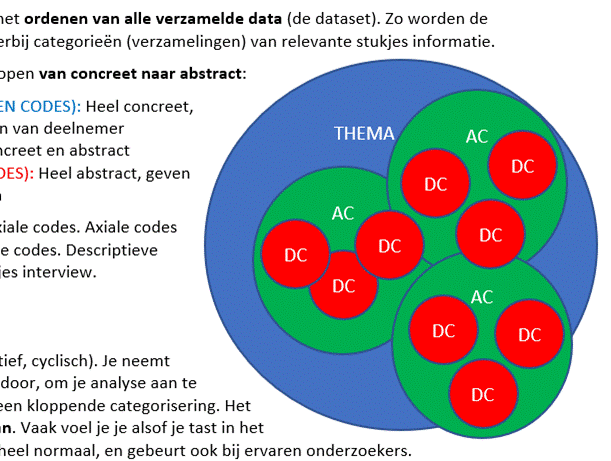
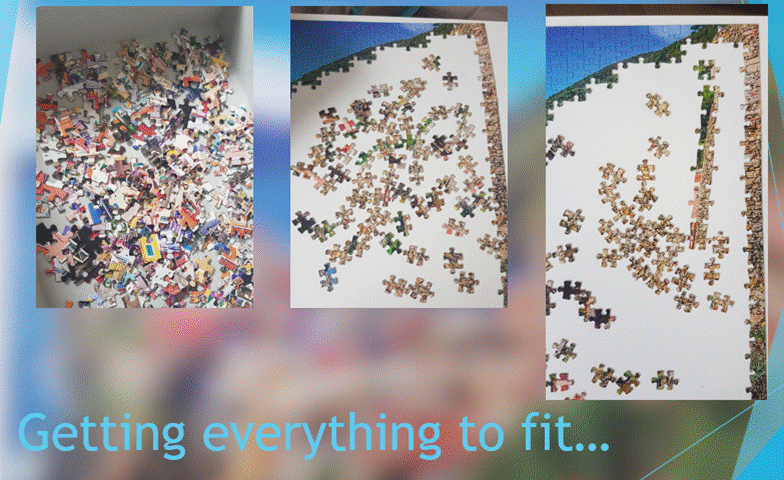
I wonder how many of us have made these guides for our thesis supervisees, after tiring of explain over and over the uncertainty of this process. How it takes a bit of working through data to get a “feel” for it, and how you know a certain point when it will all work out. when the pieces all fit together. My version of this is a Covid-era recorded lecture that is part of my MA qualitative methods course, with my then-1-year-olds’s hands all over a puzzle.
The 2025 special section Digging into Data tries to put some of these types of practical advice on display, by peeking inside the process of generating analysis with qualitative data. Part of the ongoing Thinking with Method series in Area, we collected together the real-world, as it-happens experiences of geographers who get stuck, sidetracked, bogged down, or feel pressured to cut corners in doing analysis. Our authors consider how we live with our data after it expires, and how it means something that jumps out of a spreadsheet even as it fills each individual cell.
The format – short, reflective, but well grounded papers – and focus on the practicalities of qualitative work are hallmarks of this series of special sections. Starting from considering how geographers use the spoken word, then to what they put in their field notebooks, this third edition focuses on how that data gets processed. We are at work now on the next and final special section, ‘iteration and surprise’, looking at the entire research process and how the potential for the unexpected discovery can (and should?) be worked into how we approach qualitative research. The driving question in all of these collections is simple: how are geographers actually doing this work? By collecting together these few examples, we hope they can generate a version of Gili’s two-page manual, that help us think about our practices of doing research and talk about them with our colleagues and students.
The inspiration for organizing the RGS-IBG session on ‘digging’ came in part from working on the puzzle above. Feeling around through pieces and manually sorting and categorizing them as objects works with parts of your analytical brain that are in line with what we want to activate when doing research. ‘Digging into data’ is about getting your hands dirty, in a way that recognizes that the craft of generating analysis is partly about following a set of steps that guide you towards developing an answer, and partly about the sense and intuition you develop along the way. I suspect this sense is what Maggie Maclure is talking about when advocating for the wonder of data (Maclure 2013). She describes an effort to see further than the categorizing and structuring of coding, towards being able to sense the ‘glow’ coming off of our data as we work with it. It is a feeling many of us can recognize – even my friend Gili, who is a phenomenological philosopher and STS researcher on medical practice. She and I met each other initially because of our shared interest in embodiment as a research topic; a topic which requires some ‘glow’ to be able to communicate analysis beyond reporting how people talk about their bodies.
Gili’s guide had a set of helpful questions at the end, to help students know how to know when they are finished, including these (my translation from Dutch):
Are your themes sufficiently poetic or metaphorical? Do the call up an image?
Does your analysis tell a captivating story, that shines a new light on what the participants have literally communicated?
Well – does it?
About the author: Lauren Wagner is Associate Professor in Diasporic Mobilities at Maastricht University. Her informal opinions can be found at www.medium.com/LBWagner, current projects at www.drlaru.com, and recent publications on ORCID.
Suggested further reading
Doyle, J. (2025) Emotional messiness of legal document analysis: Working with last wills and testaments. Area. Available from: https://doi.org/10.1111/area.70016
MacLure, Maggie. (2013) “Classification or Wonder? Coding as an Analytic Practice in Qualitative Research.” In Deleuze and Research Methodologies, edited by Rebecca Coleman and Jessica Ringrose. Edinburgh University Press. Available from: https://doi.org/10.1515/9780748644124
Wagner, L. & Latham, A. (2025) Talking about analysing our research material: Let’s dig into data. Area. Available from: https://doi.org/10.1111/area.70061
How to cite
Wagner, L. (2025, December) Digging into data: learning together from analysis experiences. Geography Directions. https://doi.org/10.55203/UMHX4547
 Geography Directions