

By Alan Crofts
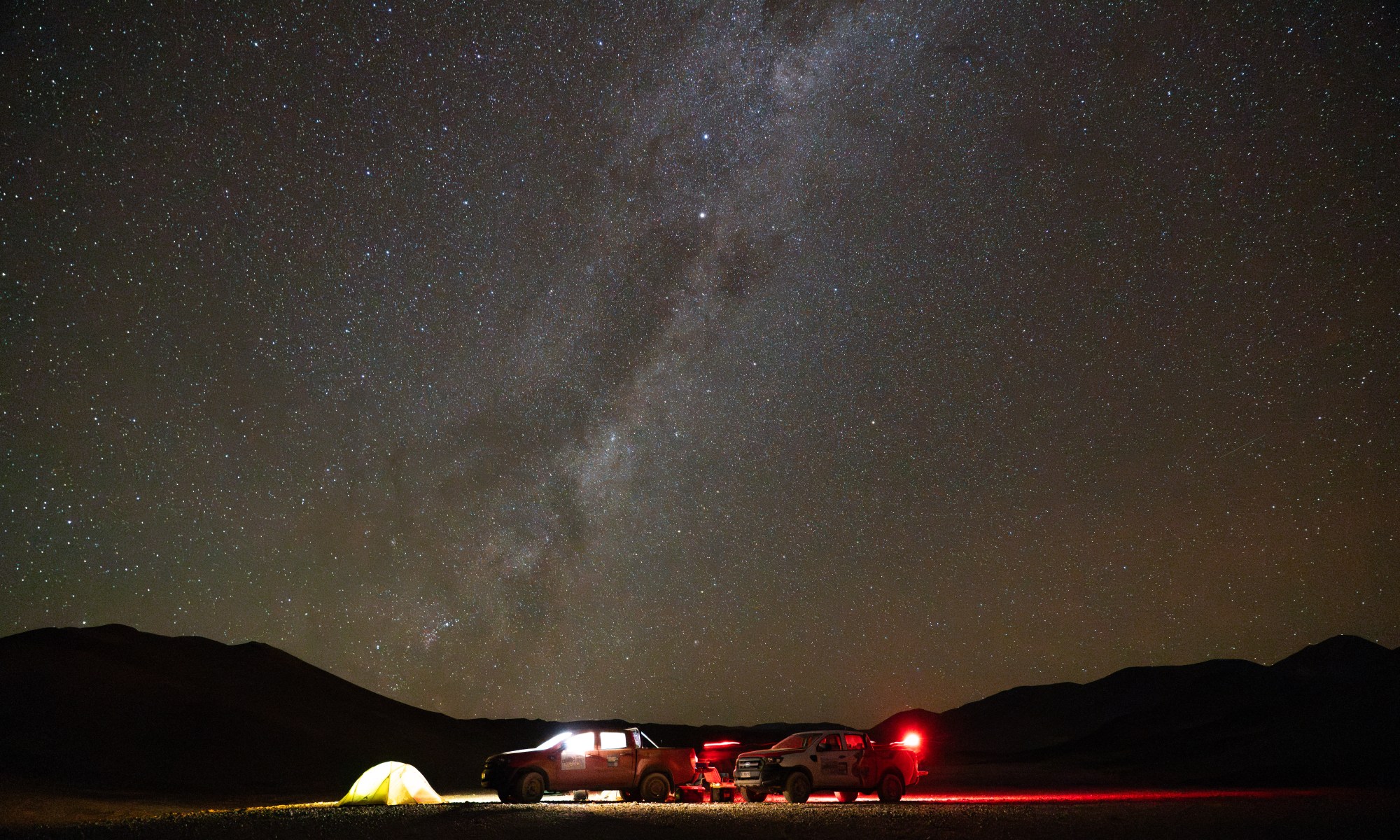
The “Into Clean Air” Expedition took place in May 2025 to demonstrate that implementing a carbon mitigating strategy is plausible in terms of using alternative biomass fuel to power remote expedition vehicles and solar voltaic mats to power equipment.
Expedition design and implementation – working it out one year from departure
The expedition explored the high arid passes of the Cordilla Oriental mountain range on the border of Chile and Argentina/Bolivia, the salt-pan system of eastern Bolivia and the central Atacama desert of Chile. The expedition was largely conducted off track and encountered deep sand/ash terrain and virgin country with steep ramps, necessitating highly capable 4×4 vehicles with low range gearing and differential lock options.
We discounted the option of using Electric Vehicles due to the lack of recharge opportunity available in remote regions. Therefore, the only practical option to demonstrate the expedition objective was to use biomass derived fuel as a substitute for regular diesel to power the vehicles. However we recognised the following pertinent issues:
- Using biofuels in internal combustion engines often requires modifications to be made depending on the biofuel type and the engine’s age and design. Generally, higher blends of biodiesel may necessitate adjustments to fuel pump and injection system. Some biofuels like Hydrotreated Vegetable Oil (HVO) can be used as a drop-in replacement for diesel however, if using unmodified vehicles, manufacturers stipulate a strict maximum percentage blend of HVO to regular diesel to remain within engine warranty parameters.
- The ethical implications of biofuels extend to broader environmental concerns. While biofuels are often touted as environmentally friendly, their production, depending on the source vegetation, can lead to significant environmental degradation, deforestation and habitat loss.
The essential element, then to accomplishing the expedition’s primary objective was to source a viable and ethical biomass diesel substitute in Chile and Bolivia. It was decided to operate the vehicles with no engine modifications to accommodate the bio-diesel as this represented the real-world state for commercial, private and industrial applications.
The vehicles used in the expedition were two Ford Ranger 2.2L TDI Pickup trucks with electronic low-range gearing and differential lock. These vehicles were chosen both for their ability to traverse severe off-road desert terrain and their load carrying capability. The manufacturer stipulates that the engine is warranted for a maximum bio-fuel ratio to conventional diesel of 1:5 (20% biodiesel blend). Therefore, we had to source sufficient biomass fuel in Chile and Bolivia – about 200 litters of biofuel for the 3200 Km expedition. However there is no commercially available biofuel in Chile and only small scale research ongoing into biomass options such as utalising off shore algae as a substrate In October 2024, the environment officer at the British Embassy in Santiago, put the author in contact with a group that educates school children in sustainable energy and collects waste cooking oil from restaurants in Santiago for processing into viable bio-diesel. This group kindly supplied the processed cooking oil. In addition, due to the interest shown in the expedition by the Bolivian Ministry of Industry we agreed to use a nationally available 20% bio-diesel blend while in that country. Bolivia is actively increasing its biofuel production to reduce reliance on imported fossil fuels and promote a more sustainable energy matrix.
To power the expedition equipment, flexible photo-voltaic panels were deployed over the flatbed area of both pick-up trucks so that power could be built up and stored in batteries during daylight whilst on the move.,
What we found out – the planning and preparation pays off
The initial part of the expedition took place in the high arid passes of the Cordilla Oriental and the high salt pans of Bolivia. To best asses the comparative functional variability in the vehicle fuelling component during this phase, one of the two identical expedition trucks (call sign Bio-Red) was ran using an increasing blend of up to 20% waste cooking oil-derived bio-fuel. The other truck (call sign Cherry-Red) was initially ran as a control using only diesel. The test environmental variables in were air temperature, altitude (decreasing partial oxygen pressure) and comparative engine performance over off-road terrain.
The average altitude experienced over the 5 days travel through the arid mountain passes was 4050 m, with a highpoint of 4880 m. This maximum altitude, (equivalent of Mont Blanc) represents an effective air Oxygen content of 11.2% compared to 20.9% at sea level. Overnight temperature averaged -14° to -16°C. Here, air temperature did not significantly rise before sun rise hit the camp and indeed both vehicles were started well before sun rise in order to perform the observations on engine performance. Both truck engines fired after a couple of seconds starting from cold and, though they ran sluggishly for about 30 seconds, there was no observable difference between performance. These observations demonstrate that adding the waste cooking oil derived biofuel had no effect in engine starting and running performance at the extreme of altitude and air temperature.
In the high, arid passes of the Cordilla Oriental the expedition often had to path-find new off-track routes. Here the surface composition was a mixture of sand and volcanic ash that displayed similar characteristics to wet sand and resulted in severe loss of traction on the upward inclines. Here it was necessary to have both vehicles in low-range gear configuration with differential lock activated so that each wheel with traction received power. An example of an incline that was traversed is shown from the Gaia navigation data. The deep sand incline, encountered at an altitude of just under 4000 m, had an average gradient of 25.2% (Figure 1).
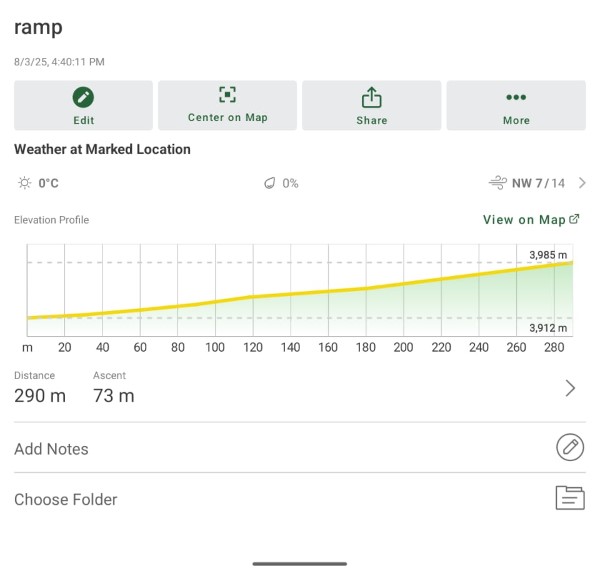
Both vehicles successfully traversed the slope, however since the ground was churned due to the passage of Cherry Red, a number of attempts was required for Bio-Red – successful only after manually levelling out ruts over disturbed ground. This extreme manoeuvre demonstrates the equivalence in engine power delivery and capability between the truck running on the bio-fuel/diesel mix and the control. The other significant test of off-road performance occurred in the crossing of the flooded Salar de Coipasa in Bolivia at 3,680 m. As the expedition entered the final 10 Km stretch the flood water progressively deepened to a maximum of approximately 60-70 cms with the surface conditions progressively glutinous. This required a relatively high-speed transit in low range gear configuration to prevent loss of traction and to create a bow wave to avoid engine flooding. Both trucks progressed with observed equity in speed and capability over this terrain.
Overall there was no observable difference in engine performance between the control and active vehicles in all the environmental parameters we tested – we showed that unmodified diesel vehicles used for remote expedition work can be run safely on waste cooking oil derived bio-fuel to the maximum allowed by the manufacturer’s warranty parameters. This finding could translate to a significant reduction in carbon emissions both in vehicles used in remote expedition and for those employed in industrial and mass-transit applications. We have made our results available to the ore-mining concerns in Chile and Santiago mass transit via the British Embassy industry liaison team.
The planning for the “Into Clean Air” expedition began in January 2024 with a view to implementing the expedition in April/May 2025. The team consisted of Dr Alan Crofts (Project Coordinator and Desert Terrain specialist), Chris Beer (Engineer and Mechanic), Alex Keefe (Expedition Photographer and tactical navigation), Kathryn Cordiner (Remote Operations specialist) and Rebecca Marsh (Travel Reporter and remote campcraft specialist).
About the author: Having an interest in desert lands from his early years Alan Crofts organised his first independent expedition in 1995 and crossed the Western Sahara desert from North to South (via Mauritania and Western Sahara); recruiting a specialised team and purchasing a used Land Rover to accomplish the project. Since then, and taking advantage of skills learnt as an Intelligence Officer in the Royal Air Force he has organised, independent pathfinding expeditions to cross the Central Sahara desert (Libya and Chad); Karakum desert of Turkmenistan (eastern dune system); AL Rub al Khali Arabian empty quarter (Oman, Saudi, UAE); Kalahari and Namib deserts of Botswana and Angola; Thar desert of Northwest India and the Chihuahuan desert of Mexico; He has also conducted solo expeditions in the Atacama desert in Chile and the Simpson desert in Australia using the Hay river track and taken part in a desert survival programme in Jordan run by the Royal Marines. He has been sponsored by industry to path find routes and water sources throughout the Eastern Sahara and the Central Asian Kyzl Kum. A Fellow of the Royal Geographical Society he has presented at the desert workshop at the Society’s annual Explore congress on a number of occasions. A biochemist by profession, Alan gained his PhD at York University in England and took up a post-doctoral research post at Johns Hopkins Medical School in Baltimore, United States of America. His book, “Desert exploration for the busy professional” that describes expedition planning and implementation specifically in arid areas, is in editorial with Gibson Square Publishing, London. He lives in Southport, England and has a 11 year-old son, Joseph.
Suggested further reading
Keddie, K., S. Beaver, E. A. Law, et al. (2025). Place-Based Sustainability Transformations for Just Futures: A Systematic Review. Geo: Geography and Environment. Available from: https://doi.org/10.1002/geo2.70040
Palmer J. (2022). Geographies of expertise in the dieselgate scandal: From a politics of accuracy to a politics of acceptability? Area. Available from: https://doi.org/10.1111/area.12581
How to cite
Crofts, A. (2026, March) Is the use of bio-fuel viable in vehicles employed in remote and challenging exploration? Results from the ‘Into Clean Air’ 2025 Expedition. Geography Directions. https://doi.org/10.55203/QZVF8946
 Geography Directions