

By Antal Wozniak, University of Liverpool, and Jill Hopke, DePaul University
The health, or lack thereof, of the humble dirt under your feet is a key component to meeting global climate action targets. Furthermore, a recently “supressed” UK government biodiversity and national security assessment cited domestic soil degradation and flooding among national security concerns for the nation’s longer-term food security. This is according to a publicly-available abridged version of the report.
Yet media coverage of climate risks to soil health as an issue of public concern is largely non-existent, according to our research. In the two years following the release of the landmark third UK Climate Change Risk Assessment 2022, we found that across all UK press outlets soil health as a climate risk was reported on a scant 42 times.
This lack of coverage is a problem for public understanding of the linkages between climate change and ecosystem function. Mainstream media both reflects and shapes how individuals understand, or don’t, climate risks. News reporting is often episodic and dependent on staged political media events. Climate change’s long timescale and complex causal links make it hard to communicate visually to audiences.
That is why when the third UK Climate Change Risk Assessment 2022 named “risks to soil health from increased flooding and drought” as one of the country’s eight priority risk areas even under low warming scenarios, we wanted to examine how soil health, as a growing climate risk, was covered in the British press. We wanted to know, firstly, is soil health reported on at all. Secondly, we were interested in how the topic is visualized in pictures and other images that accompany that coverage.
Little attention to soil health in the UK press
To test our assumption that soil health was not getting much attention in UK media, we conducted an analysis of two years of UK press coverage on the climate risk of declining soil health due to floods and droughts.
Our first finding, which emerged during our data collection, was that national and local newspapers across the country paid very little attention to deteriorating soil health because of climate change. Across more than 100 UK newspapers – including all major national publications – we found just 42 articles over a two-year period after the third climate change risk assessment report had been presented to parliament.
Unsurprisingly, The Guardian and The Independent led coverage there was during the period we studied, from 2022 to 2024. These two news outlets are known for their commitment to climate change reporting.
Some of the most widely read newspapers in the country such as The Sun, Metro, or Daily Mail did not cover the issue at all. The virtual invisibility of soil health as climate risk area in public discourse undermines the UK public’s risk awareness and political agency.
Biodiversity loss and food insecurity dominate press framing
We analysed the 42 news articles sampled in more detail for how they conveyed the issue both in writing and visually. We found that two forms of issue framing dominated: habitat/biodiversity loss and food insecurity. Articles in the first category, habitat/biodiversity loss, focused on reforestation, rewilding, the restoration of hedgerows, wetlands and peatlands, sustainable farming strategies and a crackdown on water pollution.
Food insecurity themed articles reported on aspects such as increasing food prices, subsidies for the agricultural industry, and threats to the mass production of alcoholic beverages.
Notably, we also found that coverage failed to address the root causes of climate change. Climate change was treated as a matter of fact, as an inevitable future scenario. Accordingly, mitigation efforts were not foregrounded, apart from a few references to carbon sequestration. Instead, most news reports focused on adaptive responses, and these were mostly individual or community-level initiatives.
Policymakers were all but absent in soil health news discourse, both in writing and visually. The result of this type of climate risk discourse contributes to shifting responsibility for the problem away from policy makers and the fossil fuel industry.
Generic visuals and a missing link to winter 2023/24 storms
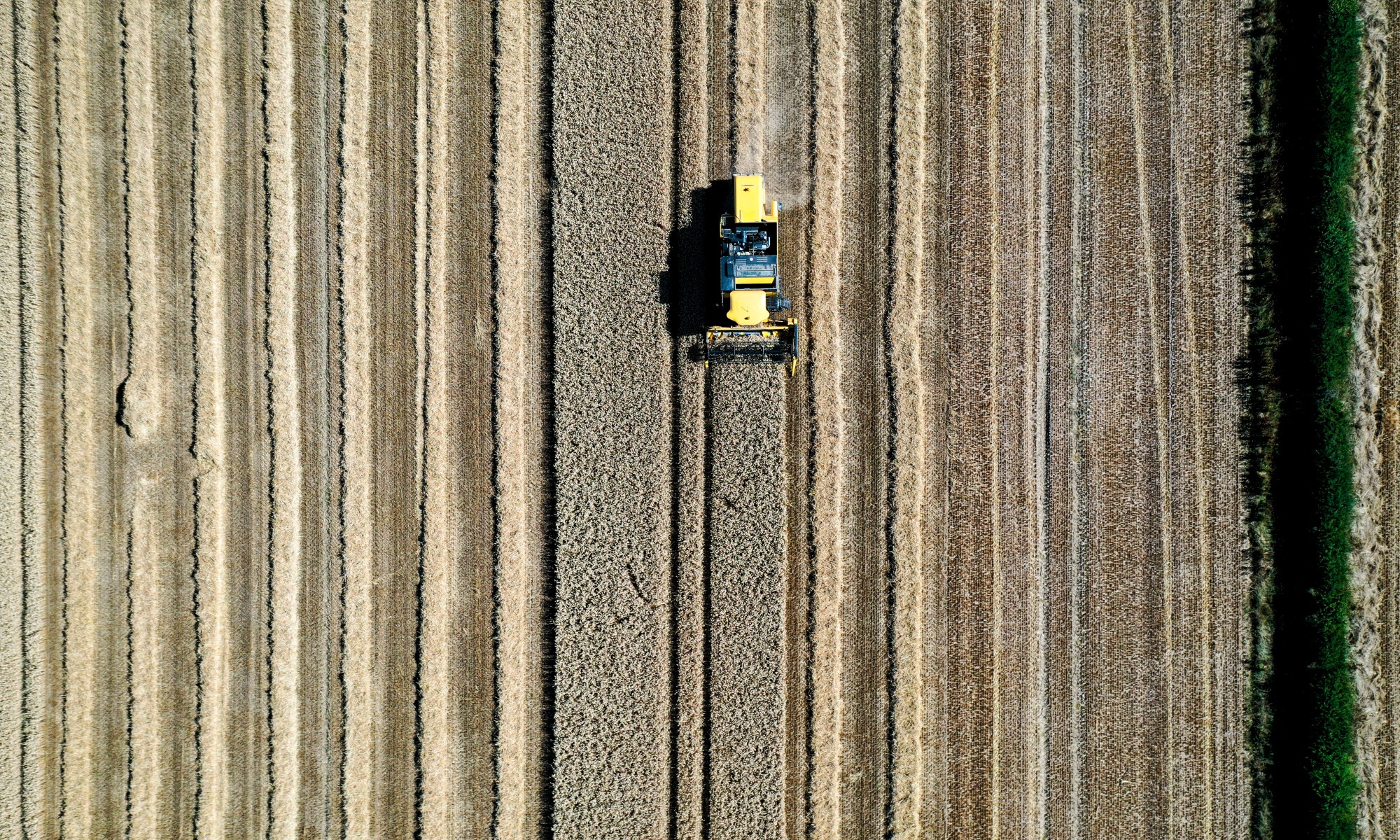
Visually, we observed, during the period we studied, ongoing use of generic imagery such as stock photography of food stuffs or supermarket aisles. Photos depicting affected communities and/or wildlife in the UK did not appear in our collection. Instead, pristine landscapes and non-descript depictions of industrial farming practices were common ways in which newspapers tried to illustrate their reports.
News coverage of soil health as a climate risk between January 2022 and January 2024 also did not refer at all to the winter 2023/24 storms (Babet, Ciarán, Henk and Isha) that led “to severe floods, at least 13 deaths, severe damages to homes and infrastructure, power outages, travel cancellations, and loss of crops and livestock,” according to the Grantham Institute. Instead, references to floods and droughts remained abstract, and images of such events were once again generic, potentially limiting readers’ propensity to connect current extreme weather events to the accelerating climate crisis.
Framing responsibility still lacking
While the news industry is under pressure from layoffs, among other factors, climate coverage has improved in recent years. Taken as a whole, though, our findings suggest the UK press is failing to adequately report on the linkage between soil health and climate change.
Following the third UK Climate Change Risk Assessment, the UK press by and large failed to make the connection between the real and deadly consequences of poor soil health and its root causes. We also found evidence of a discursive strategy political scientist Wendy Brown calls responsibilization. This is the tendency to shift the responsibility to address and adapt to the climate crisis onto the shoulders of communities and individuals – and thereby away from national and global political actors and polluting industries.
Key takeaway messages:
- Despite having been identified as a priority risk area for the UK government, risks to soil health due to climate change-induced flooding and drought is very rarely reported about in the UK’s mainstream press.
- The little coverage that exists mainly focuses on habitat/biodiversity loss and food insecurity.
- However, the root causes of climate change are rarely addressed, reporting focuses on community- and individual-level adaptive strategies, policymakers are all but absent from this news discourse, and visualizations are mostly abstract and generic.
- We conclude that, by and large, the mainstream UK press is failing to adequately cover the climate risk of deteriorating soil health. This is likely to undermine the UK public’s awareness, understanding, and responsiveness to this major problem the country faces.
About the authors:
Antal Wozniak (Ph.D., University of Mannheim) is a Senior Lecturer in Media, Politics and Society in the Department of Communication and Media at the University of Liverpool. His research focuses on political and environmental communication with an emphasis on media representations of climate change and violent conflicts. He is a member of the Research Centre for Digital Politics, Media and Democracy (DigiPol). He serves on the editorial board of the journal Environmental Communication.
Jill Hopke (Ph.D., University of Wisconsin-Madison) is an Associate Professor of Journalism in the College of Communication at DePaul University in Chicago. Her scholarship and teaching focuses on climate journalism and emerging media. She is a DePaul Humanities Center Faculty Fellow and a founding member of the International Environmental Communication Association. She serves on the editorial board of the journal Environmental Communication.
Suggested further reading
Boardman, J (2024) Communicating soil erosion in the UK: How should we present extreme events? Geographical Journal. Available from: https://doi.org/10.1111/geoj.12554
Gavin, N T, Leonard-Milsom, L, and Montgomery, J (2011) Climate change, flooding and the media in Britain. Public Understanding of Science. Available from: https://doi.org/10.1177/0963662509353377
Montgomery, D R (2024) Soil security and global food security. Frontiers of Agricultural Science and Engineering. Available from: https://doi.org/10.15302/J-FASE-2023530
O’Neill, S, and Smith, N (2014) Climate change and visual imagery. WIREs Climate Change. Available from: https://doi.org/10.1002/wcc.249
Schäfer, M S, and Painter J (2021) Climate journalism in a changing media ecosystem: Assessing the production of climate change-related news around the world. WIREs Climate Change. Available from: https://doi.org/10.1002/wcc.675
Wozniak, A., and J. E.Hopke (2025) (Not) Covering Climate Risks: A Multimodal News Framing Analysis of Soil Health Reporting in the UK Press. The Geographical Journal. Available from: https://doi.org/10.1111/geoj.70058
How to cite
Wozniak, A, and Hopke, J E (2026, March) The UK press does not widely report on climate risks to soil health. Geography Directions. https://doi.org/10.55203/KYVZ8264
 Geography Directions