

By Abdelbaseer A. Mohamed, University of Lodz
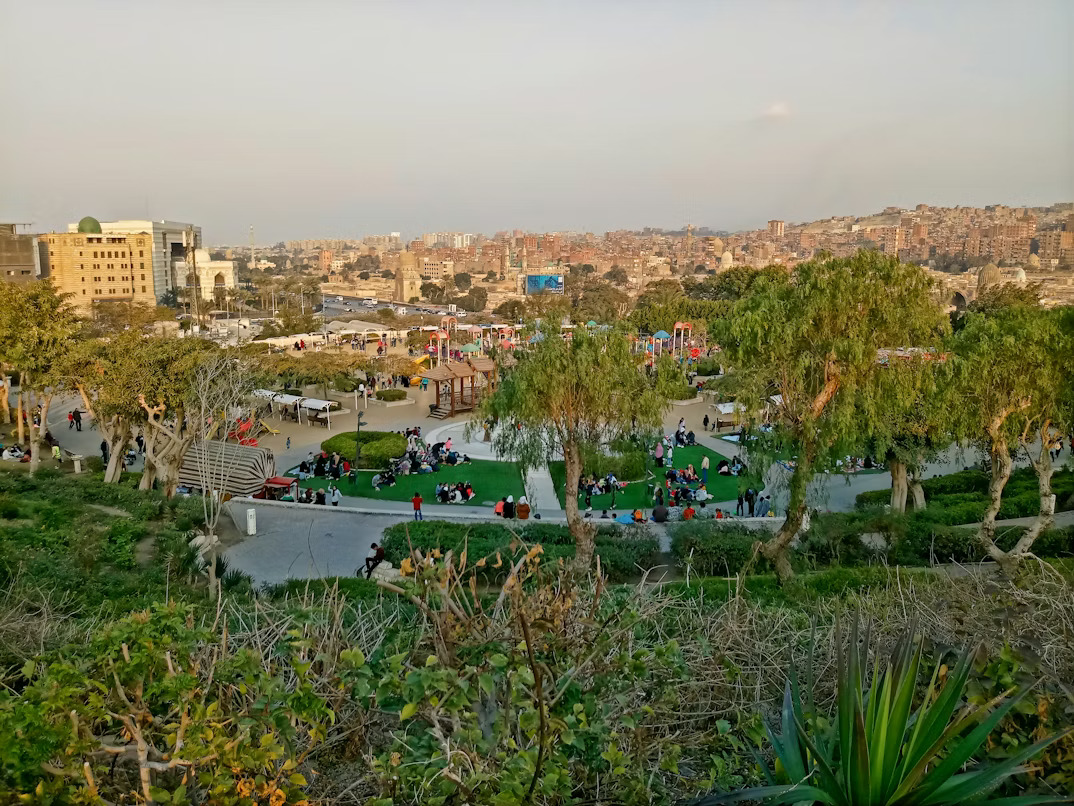
On a weekend afternoon in Cairo, families queue at park entrances, children wait their turn at ticketed playgrounds, and cafés spill into what was once an open lawn. These scenes are now familiar across the city’s public parks. They reflect not only changing leisure practices, but a deeper transformation in how urban green space is governed, experienced, and understood.
Urban parks are often described as public goods: places of respite, social encounter, and everyday contact with nature. In cities of the Global South, where green space is scarce and unevenly distributed, parks are also critical infrastructures of social life. Yet under conditions of rapid urbanisation and chronic underfunding, parks are increasingly expected to generate their own revenue. Cafés, rides, events and fenced attractions promise financial sustainability, but they also reshape what parks are — and who they are for.
Perceptions and tensions
Cairo offers a stark illustration of this tension. As one of the world’s largest megacities, it faces extreme population density and one of the lowest levels of green space per capita globally. With limited public funding, self-financing has become a dominant management strategy. Entry fees and commercial amenities help keep parks operational, but they also introduce new boundaries within spaces long imagined as common and open.
What is less clear is how these changes are perceived by park users themselves.
A recent study published in The Geographical Journal approaches this question through an unusual lens: the photographs visitors post on Google Reviews. Rather than analysing planning documents or surveying stated preferences, the research examines what people choose to photograph and share — moments they find meaningful, enjoyable, or worth remembering. These images offer insight into how commercialisation is lived and visualised in everyday park experience.
Across 17 public parks in Cairo, more than 3,000 user-generated images reveal recurring patterns. Trees, flowers and water features appear frequently, suggesting that greenery remains central to how parks are valued. At the same time, playgrounds, rides, cafés and organised activities feature prominently, especially in images centred on family outings. Crowded night-time scenes, events and food vendors further emphasise parks as lively urban destinations rather than quiet retreats.
Taken together, these images suggest not a simple opposition between “natural” and “commercial” parks, but a continuum of experiences. Some parks are still strongly associated with scenic qualities and contemplative use. Others are visually dominated by managed leisure and entertainment. Many combine both, reflecting the layered realities of urban life in a dense city.
Park homogenisation
What is striking, however, is how similar many parks appear once viewed through this visual lens. Certain commercial features — fenced areas, cafés, ticketed attractions — recur across almost all sites, regardless of size, location or history. The result is a gradual homogenisation of park landscapes, where distinct ecological and cultural identities are softened by standardised leisure infrastructure.
This matters because parks are not simply green spaces; they are social and cultural commons. They carry histories, routines and shared meanings built through repeated use. When access becomes conditional on payment, and when leisure is increasingly organised around consumption, the character of public space subtly shifts. Publicness is not abolished outright, but reworked — from an open commons to a managed, semi-commercial environment.
From a geographical perspective, this transformation cannot be understood solely in terms of efficiency or revenue. It raises questions about use value and exchange value, about who benefits from commercialisation and who is quietly excluded. While many visitors welcome improved amenities and family-oriented facilities, the cumulative effect of entrance fees and paid attractions can limit access for those with fewer resources, reinforcing socio-spatial inequalities.
Conclusions
The study’s use of user-generated images highlights another important point: perception matters. What people photograph becomes part of how parks are collectively imagined. Visual emphasis on rides, cafés and fenced attractions signals a shift in what counts as a “successful” park experience. Over time, these images help normalise a particular vision of urban nature — one oriented towards consumption rather than common use.
Although rooted in Cairo, these dynamics resonate far beyond Egypt. Cities across Africa, Asia and Latin America face similar pressures as they seek to maintain public spaces under fiscal constraint. In many cases, commercialisation is presented as pragmatic or inevitable. Yet the Cairo case suggests that its implications for publicness, identity and belonging deserve closer attention.
The geography of urban parks, then, is not only about design or maintenance. It is about how space is shared, regulated and imagined. If parks are to remain meaningful public places, the challenge is not simply how they generate revenue, but how commercial activity is balanced against the social value of openness, diversity and everyday access.
In an era of growing inequality and environmental stress, this balance matters deeply. Cairo’s parks remind us that public space is not lost all at once. It is gradually reshaped through small decisions about fences, tickets, and amenities — and through the everyday practices of those who enter, linger, and take photographs of what they find there.
About the author: Abdelbaseer A. Mohamed is an associate professor at Al-Azhar University, Faculty of Engineering, Urban Planning Department. He is also a researcher in residence at the Social-Ecological Systems Analysis Lab, Faculty of Economics and Sociology, University of Lodz. His research explores interactions between society and space, particularly from the perspective of urban morphology. He is a space syntax expert with over 10 years of experience.
Suggested further reading
Mohamed, A. (2026) Commercialisation and Visitor Perceptions of Cairo’s Urban Parks: A Machine Learning Analysis of User-Generated Images. The Geographical Journal. Available from: https://doi.org/10.1111/geoj.70065.
Mohamed, A. A. (2025) Selling Public Parks: How Social Media Marketing Is Shaping the Commercialization of Urban Spaces in Cairo.” World Leisure Journal, Advance online publication. Available from: https://doi.org/10.1080/16078055.2025.2605232.
Mohamed, A. A. (2025) Urban Park Commercialization and the Transformation of Public Space in Cairo. Annals of Leisure Research, Available from: https://doi.org/10.1080/11745398.2025.25608
Layton, J. (2025) Counting in qualitative fieldwork: Notes from a large urban park. Area. Available from: https://doi.org/10.1111/area.12926
Turnbull, J., Fry, T. & Lorimer, J. (2025) (Re)wilding London: Fabric, politics, and aesthetics. Transactions of the Institute of British Geographers. Available from: https://doi.org/10.1111/tran.12748
How to cite
Mohamed, A. (2026, February) When green space becomes a product: commercialisation and the fragile publicness of Cairo’s parks. Geography Directions. https://doi.org/10.55203/PKUZ6227
 Geography Directions