

By James Riding, Newcastle University
A new atlas initiated by Newcastle University geographer offers a contemporary view of life in Bosnia and Herzegovina thirty years after the series of secessionist wars that ravaged the western Balkans in the 1990s as Yugoslavia collapsed.
This blog post extends a recent themed intervention in Transactions of the Institute of British Geographers published by Annelys De Vet on participative design and situated mapping.
What is the Subjective Atlas of Bosnia and Herzegovina?
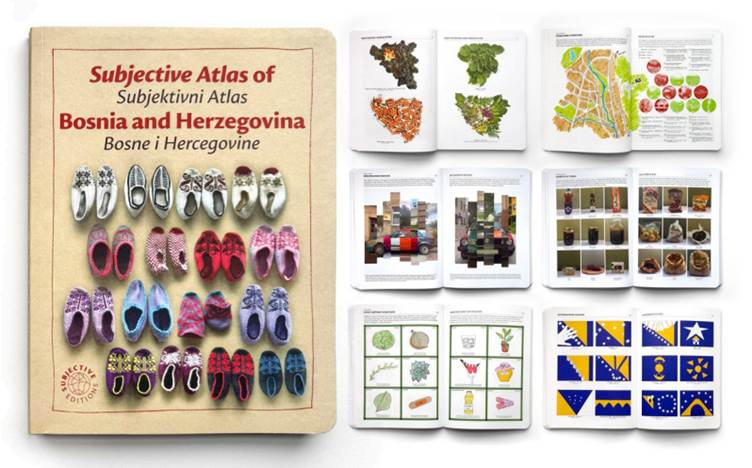
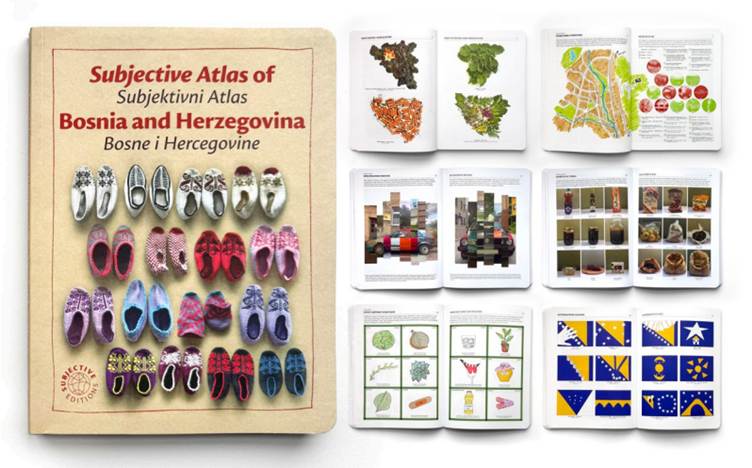
Working with two NGOs, Sarajevo-based Post Conflict Research Center and Subjective Editions in Brussels, the project funded in part by the Royal Geographical Society brought together more than 80 young people from across Bosnia and Herzegovina to create their own personal maps of everyday life and memories of a country too often defined by outsiders.
“I would like to say how much I enjoyed working on this project. I love being creative, and sometimes you just need to process heavy topics through art. I often think about those days when we were drawing and cutting paper.”
— Amila Čandić, participant
“With every page, I discover aspects of Bosnia that I (and I imagine many others) tend to overlook in daily life. Yet when I see them laid out so thoughtfully, my first reaction is, “Oh yes, I’ve never noticed that, but it’s so Bosnian!” It will leave a lasting impression on everyone involved—and many beyond. “
— Melisa Sinić, participant
The atlas was recently launched at Vijećnica (Sarajevo City Hall) to coincide with other events to mark the 30-year anniversary of the signing of the Dayton Agreement, which was initialled in Dayton, Ohio, on 21 November 1995. The agreement, which was re-signed ceremonially in Paris on 14 December 1995, ended the three-and-a-half-year-long war in Bosnia. The agreement separated Bosnia and Herzegovina into two ethnically-defined entities, known as Federacija Bosne i Hercegovine and Republika Srpska, creating a complicated political structure and legislation that recognises three constituent ethnic groups and seventeen national minorities.
During the launch event at Vijećnica, Samir Avdić, mayor of Sarajevo, said:
“Today, the city hall once again becomes a symbol of meeting, dialogue and common reflection. We are proud that Sarajevo has the honour of hosting young authors whose works show the power of creativity and hope for the future of Bosnia and Herzegovina. Their drawings, maps, and photographs remind us that peace is not only the absence of conflict, but also a space that we must constantly build anew.”
Why make a subjective atlas of Bosnia and Herzegovina?
Bosnia and Herzegovina is so full of outsiders telling stories that the weight of reports marked war and geopolitics might upend the Balkan peninsula, leaving a mountain bobbing between the Adriatic and the Black Sea with Greece at its summit. It is a place that has for decades been simplistically defined by maps depicting the boundary line which subdivides Bosnia and Herzegovina. International journals and newspapers have regularly published pieces since the end of the 1992 to 1995 war which largely tread the same path and state that the country is divided into two entities and Brčko District and contains three distinct constituent ethnic groups.
We aim in the new Subjective Atlas of Bosnia and Herzegovina to offer instead a collection of personal, visually striking stories and maps from rural and urban landscapes across this beautifully diverse country to change the often-told story of division locally and internationally. Yet it is the map that traditionally gives borders a certain legitimacy in international law. This is referred to as the power of maps by geographers and relates to a long-held popular belief that a map objectively represents space. In our new atlas of Bosnia and Herzegovina, you will see that we subvert the traditional map, showing the reader a series of human interactions with the landscape by mapping the everyday entanglements of places and people. These maps are created by lots of hands, and they do not provide an objective view, or an accurate representation of the territory of Bosnia and Herzegovina. On the contrary, one map looks like a cat clawing at the lines drawn across the country thirty years ago, while others depict heart-shaped collections of cigarette butts and local flora. Collectively they show that a country is more than its outline, its borders, both internal and external.
There are maps in our atlas that are what you might call political and reveal the frustration that many citizens feel today in the country. Importantly, the new atlas does not deny the conflict affected present, and the experiences of citizens during an endless transition era, marked by ethno-nationalism, mass unemployment, nepotism, corruption, and brain drain, with young people who have inherited trauma from older generations being some of the hardest hit. Yet what is also present in our atlas are stories that you might not have encountered, as maps here go further than defining this place only in terms of war and its aftermath. There are acts of solidarity here that depict a collective desire to reimagine the country and move beyond the decades-long political impasse. One map for instance shows how this political stagnation is precipitating an urgent public health crisis in the country as its cities are now among the most polluted places on earth. Together these personal maps remember the traumatic past, acknowledge the difficult present, and hope for a better future.
The atlas is not a complete story of Bosnia and Herzegovina. It explicitly states on the front cover that this is a subjective story of the country. A focus on the subjective is perhaps uniquely appropriate in a place where the voices of those who experienced war and its aftermath, the traumatic, environmental, and material legacies of conflict, are often missing from reports and studies. We hope the atlas provides a unique representation of Bosnia and Herzegovina that all those who call Bosnia and Herzegovina home, can find a little bit of their home in.
The atlas is published in both English and Bosnian, Croatian, Serbian (BCS) and is available in bookshops in Bosnia and Herzegovina. You can get your own copy of the atlas via the website of the publisher Subjective Editions for €27.50 (Subjective Atlas of Bosnia and Herzegovina — Subjective Editions) and a PDF version of the book is also available for €6.00 (Subjective e-Atlas of Bosnia and Herzegovina — Subjective Editions).
You can watch a film about the making of the atlas here.
___________________________________________
About the author: James Riding is a cultural and political geographer with research expertise in the western Balkans. His research advances the geographies of landscape, the geographies of memory, and the geographies of conflict, and shapes the wider interdisciplinary fields of memory studies, peace and conflict studies, and landscape studies. He has published widely in international journals and has written four books: The Geopolitics of Memory, Reanimating Regions, Land Writings, andSubjective Atlas of Bosnia and Herzegovina.
Suggested further reading
de Vet, A. (2025) Making a Subjective Atlas of Palestine: On participative design and situated mapping. Transactions of the Institute of British Geographers. Available from: https://doi.org/10.1111/tran.12706
Duggan, M., & Gutiérrez-Ujaque, D. (2025). Counter-mapping as praxis: Participation, pedagogy, and creativity. Progress in Human Geography. Available from: https://doi.org/10.1177/03091325251348610
Riding, J. & De Vet, A. (eds.) (2025). Subjective Atlas of Bosnia and Herzegovina / Subjektivni Atlas Bosne i Hercegovine. Brussels: Subjective Editions.
Riding, J. (2019) The Geopolitics of Memory: A Journey to Bosnia. Stuttgart: ibidem-Verlag.
Funding
The author disclosed receipt of the following financial support for the research, authorship, and/or publication of this article: The project was made possible through a NUAcT Fellowship held by Riding at Newcastle University, with additional funding obtained through an ISRF small group grant, an ESRC IAA grant, an RGS-IBG small group grant, and an ISPF ODA grant.
How to cite
Riding, J. (2026, January) Subjective atlas presents alternative geography of Bosnia and Herzegovina. Geography Directions. https://doi.org/10.55203/EKVM1272
 Geography Directions