

By Charlotte Weatherill, University of Manchester
Where you start any story matters. Especially when describing how a problem came to be, your starting point establishes what has caused it, and therefore what solutions might look like. This is something that Alice Te Punga Somerville well understood when she wrote her book, ‘250 Ways to Start an Essay about Captain Cook’. While the subject of Te Punga Somerville’s contribution was colonisation in Aotearoa and the Pacific, I have taken this idea and applied it to climate change.
In the Pacific this is vital. In the dominant climate story, climate change has arrived in the region as a world ending event. Doom is inevitable, and for Pacific people, their futures lie in refugeehood or in the digital realm.
An alternative story, which I advocate in line with a growing number of critical scholars, is that climate change is not new, it is merely one manifestation of the waves of violence that have been wrought upon the region. In other words, the story of harm in the Pacific is not only a story of the failure to keep temperature rises to 1.5 degrees. Telling the story in this way completely skips what has actually led us to this point. Namely, the long project of domination and exploitation that is European imperialism.
Climate change didn’t begin with the industrial revolution
In the authoritative story of climate change, as represented by the IPCC, the problem began with the industrial era, when greenhouse gas emissions began to rise exponentially. This understanding is evident in its choice of the 1850-1900 baseline. Solutions therefore come from limiting those emissions coupled with adaptation projects. Yet many others are telling a different story, drawing links between nuclear imperialism, capitalism, colonialism, and climate change. According to this view of the problem, solutions look very different, including the need for contesting all of these structures of power.
In my recent article I experimented with a storytelling method to demonstrate the politics and the implications of these two different versions of the story. I do this to challenge the idea that one version represents objective climate ‘science’, and the other version is subjective, representing climate ‘activism’. Instead I am saying that both are as political as one another, and both are interpretations of reality. In other words, all stories are political, and all politics is stories.
Loss and damage: thinking from Vanuatu
Take the example of loss and damage. The IPCC is very careful about how it defines Loss and Damage, and losses and damages. The formerrefers to political debates mediated through the UNFCCC, whilst the latter refers more broadly to harm caused by climate change. This term was introduced to international negotiations in 1991 by Vanuatuon behalf of AOSIS in order to argue for an insurance scheme to compensate small island states along with low-lying developing countries for loss and damage resulting from the consequences of sea level rise. This formal meaning has been arrived at after softening the interventions by island state leaders and climate activists who use stronger language, such as that of reparations.
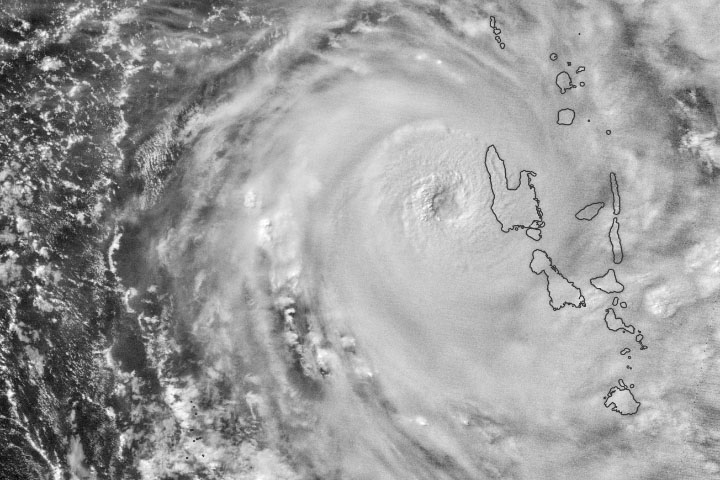
Another way of telling this story, is that climate change is a result of ‘imperial mess’. In this version, the story of loss and damage in Vanuatu is a story of colonisation, a story of the struggle for independence, a story of Christian missionaries, of the sandalwood trade, of blackbirding (the phrase used to describe the practice of kidnapping Pacific Islanders for coerced and enslaved labour) and deforestation. In this story, the core problem is a global economic system of racial capitalism that has been causing losses and damages in Vanuatu and across the Pacific for hundreds of years. In this system, ni-Vanuatu and the land of Vanuatu have been stolen, logged, pressed into enslaved labour, occupied and destroyed by the US military. Reducing what happens to a land and people that experience cyclones as ‘climate vulnerability’ does a disservice to them, and also misunderstands what should be considered the baseline for repair.
Juxtaposing these stories shows stark differences in how climate change is viewed as a problem. The IPCC story is extremely technical and reflects how loss and damage is currently a key site of struggle in mediating strict boundaries of what is considered in the scope of climate politics. The fixation on attribution is vital for the IPCC’s story as loss and damage cannot be allowed to expand into broader conversations of reparations. However, in the anti-imperial story, there is no separation between the harms of colonialism, nuclear imperialism, capitalism and climate change. Attribution is evident in the histories of the islands, where the actions of the past are not absent in the present, and there is no way to untangle deforestation and cyclone damage, and no way to know what effects there would have been from a cyclone without the centuries of harm that preceded its landfall. To me, this clearly demonstrates why climate change must be understood as part of the imperial project.
Conclusions
The argument that I am making here is that understanding the story of climate change as a story of imperialism – or not – is not a matter of differing theoretical frameworks. If climate change is not historicised and placed within the context of a longer history of multiple violences, all enacted for the enrichment and empowerment of some people and places over others, then the problem is being wrongly named and the solutions that are proposed will be insufficient.
Researchers across the climate field, especially adaptation and loss and damage scholars, need to reckon with their own starting points for the climate story. It is my argument that without this historical reading, the causes of climate change are misunderstood and underestimated, and therefore, the solutions cannot address the scale of the problems faced by colonised and vulnerabilised regions, and by all of us.
About the author: Charlotte Weatherill is a Lecturer in Environmental Politics at the University of Manchester. Charlotte’s research explores the concept of vulnerability in climate change politics, particularly in relation to Oceania and historical patterns of coloniality. Her research interests include environment and climate change politics, and theories of feminism, colonialism and racial capitalism. She is also a co-founder and co-convenor of BISA’s Environment and Climate Politics working group.
Suggested further reading
Barnett, J., Farbotko, C., Kitara, T. and Aselu, B. (2025). Migration as Adaptation? The Falepili Union Between Australia and Tuvalu. WIREs Climate Change. Available from: https://doi.org/10.1002/wcc.924
Maurer, A. (2024). The Ocean on Fire: Pacific Stories From Nuclear Survivors and Climate Activists. Duke University Press. Available from: https://doi.org/10.1215/9781478059059
Mercer, H., & Simpson, T. (2023). Imperialism, colonialism, and climate change science. WIREs Climate Change. Available from: https://doi.org/10.1002/wcc.851.
Te Punga Somerville, A. (2020). Two Hundred and Fifty Ways to Start an Essay About Captain Cook. 1st ed. Bridget Williams Books. Available from: https://doi.org/10.7810/9781988587745
Tunn, J. (2025). Epistemic Violence in Global Climate Governance: The Case of Climate Finance in Vanuatu. Geo: Geography and Environment. Available from: https://doi.org/10.1002/geo2.70036.
Weatherill, C.K. (2023). Sinking Paradise? Climate change vulnerability and Pacific Island extinction narratives. Geoforum. Available from: https://doi.org/10.1016/j.geoforum.2022.04.011
How to cite
Weatherill, C. (2026, January) Where do you start the story of climate change? Geography Directions. https://doi.org/10.55203/UOEC9828.
 Geography Directions