

By Christos Tsampoulatidis
The reflections presented here stem from my involvement in the project Disaster Risk Creation in Urban Resettlement Processes, conducted at the Copenhagen Center for Disaster Research, University of Copenhagen. This blog post draws extensively from a preprint, available here.
Polluted rivers and precarious livelihoods: the river as a resource and a hazard
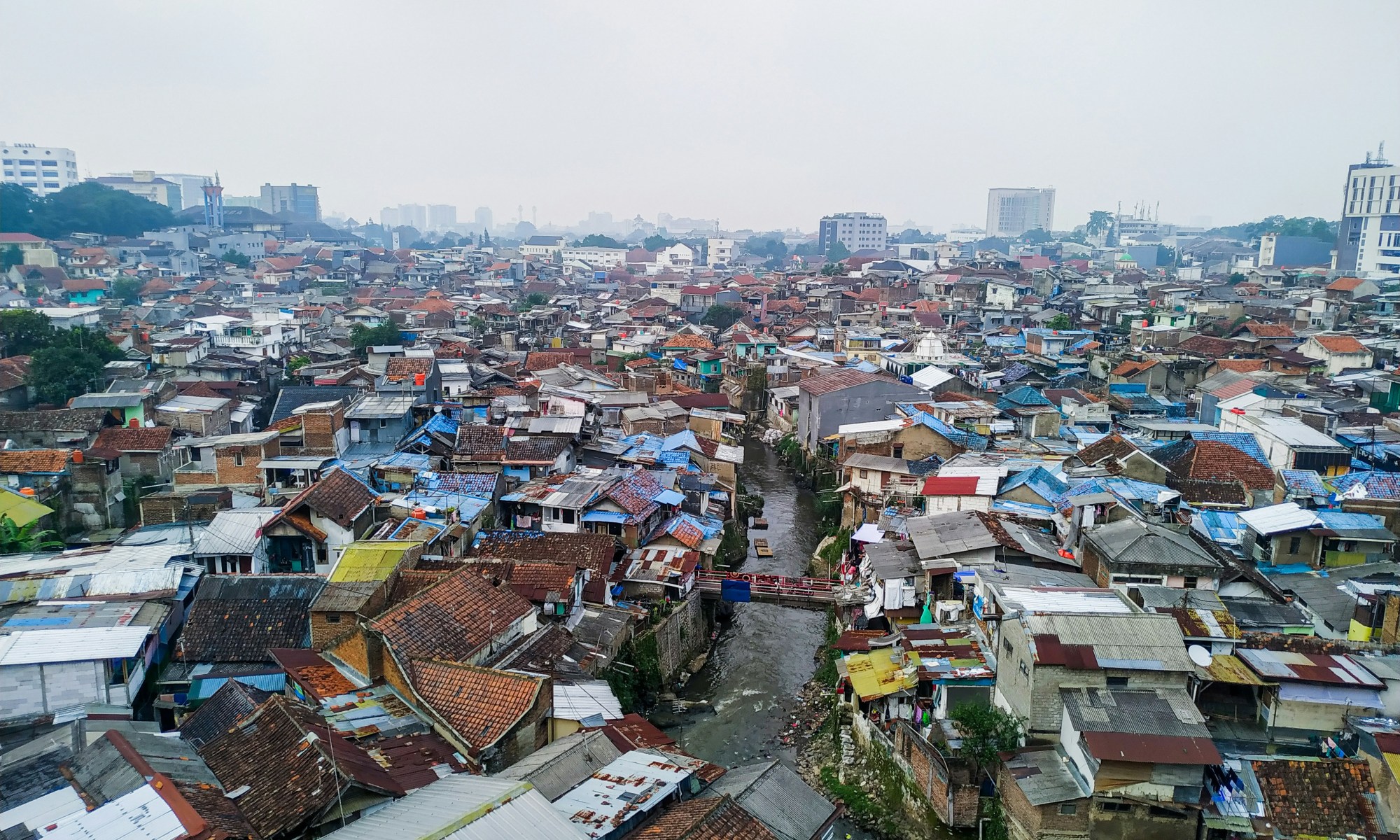
Urban rivers in cities in the Global South are often polluted and degraded, due to haphazard development, inadequate infrastructure and rapid population growth. It is most often the poor and marginalized urban communities that have no choice but to reside by the polluted riverside and pursue their livelihoods in that environment.
The river may be hazardous but also functions as a resource. For example, riverside communities in Nigeria’s Federal Capital Territory engage in animal husbandry, agricultural production, and small businesses that rely on polluted river water. Additionally, urban agriculture utilizing such water has been observed in Nairobi and Addis Ababa. Arguably, the whole community’s livelihoods are tied to the river. One may reside by the riverside and derive their primary income from work unrelated to it (such is the case in many Indonesian kampungs (defined as informal settlements by UN Habitat), with day labor, trading, construction, taxi driving, and government work). But the food one might consume can be produced using polluted river resources, exposing communities to hazards that in turn could adversely affect their health and opportunities to earn a living. This pervasive dependence on the river renders livelihoods extremely precarious.
In turn, these livelihoods inevitably exert pressure on the river too. As these communities often lack access to basic hygiene and sewage infrastructure, their waste ends up polluting their local environment. In this process, they inevitably contribute not only to river degradation, but also to their own increased exposure to biological and flooding hazards. In public discourse, these communities are often portrayed as solely responsible for putting the entire city at risk. For example, media narratives in Jakarta have frequently pointed to informal settlements as the root cause of disastrous floods. However, these communities’ living conditions are the result of social injustices – and their infrastructure and sanitation needs are neglected by relevant authorities, which also exacerbates river pollution.
In fact, a more nuanced analysis reveals that failed developmental projects have significantly contributed to river degradation in several cases in the Global South. For example, construction projects have been shown to result in river encroachment in the case of Hyderabad, India. The severe pollution in the cases of Nairobi, Kenya, Addis Ababa, Ethiopia, and Marikina City, Philippines can be attributed to the shortcomings of the urbanization process of the city. In Jakarta, Indonesia, drastic reduction of public spaces in the city has decreased ground permeability, and thus significantly contributed to land subsidence and increased flood risk. These examples illustrate the extreme burden that haphazard development takes on its environment and the state of the urban rivers in its proximity.
As one would expect, the combination of failed development, neglect and disregard for the riverside communities often leads to a tipping point, i.e. a disastrous flooding event. When this occurs, the previous way of living becomes unsustainable, and the resettlement of a community is often depicted as the only option to ensure their protection. After all, as Oliver-Smith argues, reduction of exposure to a specific hazard is “at the heart of resettlement” as a process.
Resettlement: is reduced exposure to the hazard enough?
Resettlement carries very tangible risks with it, as there is often no legal protection of persons that are displaced “by causes such as climate change, environmental disruption, disasters or development projects”. It is important then to assess a resettlement process on whether it has succeeded in reducing exposure to the hazard but also whether it has safeguarded the community against further impoverishment.
On the one hand, some studies argue that livelihoods can indeed recover in the long-term post-resettlement. In their study of a post-flooding relocation in Indonesia, Astuti et al. argue that livelihoods were rebuilt in due time, mainly in the form of small, home-based businesses. In their case, it was the resettlement location itself that posed a twofold risk to livelihood activities. Firstly, the relocation area lacked access to basic infrastructure, such as water availability and secondly, it would restrict work opportunities due to its geographic remoteness. Local government crucially provided support for water supply systems, road infrastructure and land title certifications which supported the rebuilding of livelihoods. In another case, Lauer et al. detail the resettlement of a community in Manila. They stress the importance of incorporating multiple indicators (safety from hazards, income recovery, access to infrastructure etc.) in assessing the community’s recovery process. The communities restructured their livelihood activities over time, either by participating in the newly formed economy within the resettlement site or by venturing out for labor work. Off-city sites provided fewer work opportunities compared to their in-city counterparts, while the communities’ ability to save money saw a substantial decrease compared to pre-resettlement. However, the authors also argue that living standards saw a net increase due to increased access to services, which played a balancing role. Overall, they underline the importance of provision of enough resources (basic services, security in land tenure) for people to get out of chronic poverty in the resettlement process.
On the other hand, a resettlement process can also exacerbate the problems that marginalized communities face. In the case of flooding in coastal Sri Lanka, relocated households had to contend with both a disruption to their everyday work and added costs for transportation, utilities and infrastructure that they were not prepared for. This drastic decline in household income contributed to parts of the community deciding to voluntarily return to the flood-prone zones, despite the risks. Other evidence that is emerging from Ahmedabad, India, highlights that resettlement can perpetuate impoverishment and social inequalities. In their study of resettlement of communities displaced by urban development projects, Patel et al. note that religious minorities and oppressed castes were overrepresented in the displaced population. As they were offered resettlement far away from the site of displacement, it led to loss of employment and children dropping out of school due to insufficient transportation. These factors increased the risk of chronic impoverishment. Many families incurred debts to build new housing units for themselves. Others did not possess documents that made them eligible for the new housing units in the resettlement sites. Finally, almost one-fifth of allocated new units remained empty, as the community preferred to stay near its social networks rather than face social fragmentation.
In conclusion, resettlement is a complex process that is disruptive to livelihoods and can potentially exacerbate existing inequalities. Reduction of exposure to one specific hazard through resettlement does not guarantee improvement in living conditions. While difficult and challenging, living by a polluted urban river provides opportunities for livelihoods to be built. Resettlement cannot simply be imposed by sheer power, because there is always the possibility of people simply returning to the pre-resettlement location. It is thus imperative that resettlement processes be rethought with the livelihood needs of the marginalized communities at the forefront.
About the author: Chris Tsampoulatidis is an early-career researcher, holding an MSc in Global Health with a specialization in Disaster Risk Management. He has worked on projects on human geography and migration in Bangladesh, disaster risk management in India, and crisis communication in North American social media. He can be reached on LinkedIn here.
Suggested further reading
Akther H, Ahmad MM. Livelihood under stress: The case of urban poor during and post-flood in Dhaka, Bangladesh. The Geographical Journal [Internet]. 2021 Sept;187(3):186–99. Available from: https://rgs-ibg-onlinelibrary-wiley-com.ep.fjernadgang.kb.dk/doi/full/10.1111/geoj.12379
Doshi S. Imperial Water, Urban Crisis: A Political Ecology of Colonial State Formation in Bombay, 1850–1890. Review (Fernand Braudel Center) [Internet]. 2014;37(3–4):173–218. Available from: https://www.jstor.org/stable/90011609
Kaker SA, Anwar NH. From one flooding crisis to the next: Negotiating ‘the maybe’ in unequal Karachi. The Geographical Journal [Internet]. 2024;190(1):e12498. Available from: https://onlinelibrary.wiley.com/doi/abs/10.1111/geoj.12498
Parpiani M, Goswami S, Sen S, Joseph J, Raju E. Habitability, viability and disaster risk creation in urban India. Urban Geography [Internet]. [cited 2025 Oct 20];0(0):1–12. Available from: https://doi.org/10.1080/02723638.2025.2557352
How to cite
Tsampoulatidis, C. (2025, December) Urban river livelihoods: why moving communities isn’t always the answer to floods. Geography Directions. https://doi.org/10.55203/THBY3637
 Geography Directions