


By the States of Precarity team: Rachael Squire, James Esson, Johanne Bruun, Rachel Colls, Peter Forman, Anna Jackman, Jasmine Joanes
A new Report and set of Best Practice Action Plans explore the changing states of precarity in UK University Geography as they are experienced across career stages in diverse ways.
The Report and Action Plans, designed to enable and support positive change within the sector, are informed by a discipline-wide survey conducted in 2023, which captured the views of 364 respondents (approximately 10% of academics working in Geography in Higher Education in the UK), from PhD students through to Professors. Focus groups with academic geographers across career stages (including Heads of Departments, those on permanent and fixed term contracts (FTCs), PhD students, and those who have left academia) informed the Action Plans which reflect on what best practice might look like, and how it can be embedded throughout UK Geography Departments.
In light of the far-reaching effects of precarity beyond contractual terms, precarity is defined throughout the Report and Action Plan as:
‘Employment conditions that do not enable the living of a fulfilling life’ and which prevent employees from ‘planning for the future’ (Survey Participant, 2023).
The Report: a key summary
Precarious working conditions are endemic throughout the academy. This has only intensified in the last two years, with widespread redundancies, mergers, and restructuring occurring across the sector. In this context, the Report provides an in-depth account of how fixed-term contracts (FTCs), structural insecurity, and institutional cultures shape the professional and personal lives of geographers across career stages.

Our key findings include:
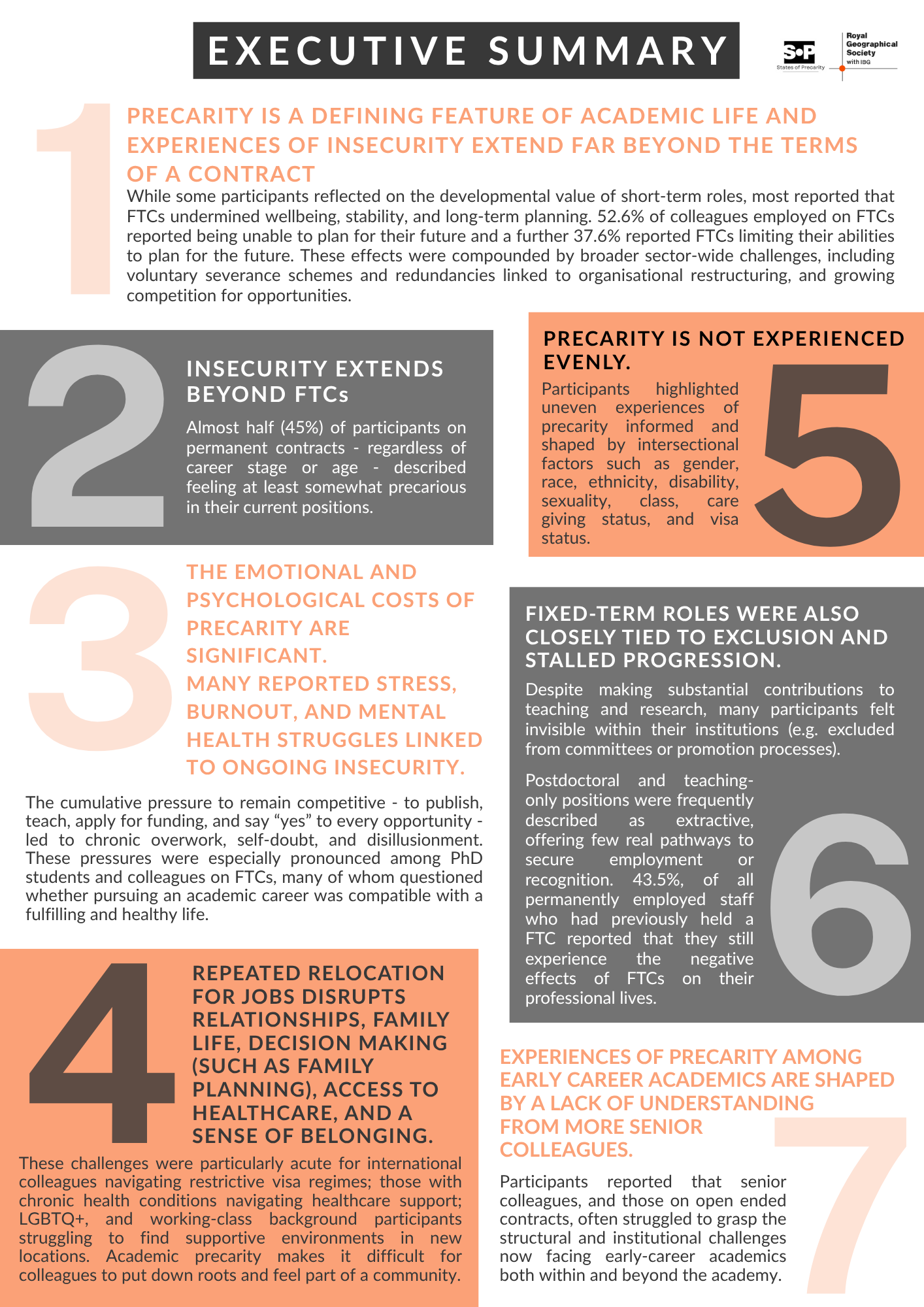
- Precarity is a defining feature of academic life and experiences of insecurity extend far beyond the terms of a contract. While some participants reflected on the developmental value of short-term roles, most reported that FTCs undermined wellbeing, stability, and long-term planning. Over 50% of colleagues employed on FTCs reported being unable to plan for their future, with a further 37.6% reporting that FTCs limited their ability to plan for the future.
- Insecurity extends beyond FTCs. Almost half (45%) of participants on permanent contracts – regardless of career stage or age – described feeling at least somewhat precarious in their current positions. Extended probation periods, unclear expectations, and shifting institutional priorities contributed to a climate in which stability felt conditional and temporary.
- The emotional and psychological costs of precarity are significant. Many participants reported stress, burnout, and mental health struggles linked to ongoing insecurity. 49.4% of colleagues on permanent contracts reported long lasting negatives effects of FTCs on their wellbeing, while 84.9% of colleagues on FTCs reported that their contracts had negative impacts upon their wellbeing. The cumulative pressure to remain competitive – to publish, teach, apply for funding, and say “yes” to every opportunity – led to chronic overwork, self-doubt, and disillusionment. These pressures were especially pronounced among PhD students and colleagues on FTCs, many of whom questioned whether pursuing an academic career was compatible with a fulfilling and healthy life.
- Repeated relocation for jobs disrupts relationships, family life, decision making, access to healthcare, and a sense of belonging. 48.1% of colleagues on FTCs had to move home to accept an academic job, whilst 46.1% of colleague on permanent contracts had to relocate at least once before securing permanent employment. The challenges of relocation were particularly acute for international colleagues navigating restrictive visa regimes; those with chronic health conditions navigating healthcare support; LGBTQ+, and working-class background participants struggling to find supportive environments in new locations. Academic precarity makes it difficult for colleagues to put down roots and feel part of a community.
- Precarity is not experienced evenly. Participants highlighted uneven experiences of precarity informed and shaped by intersectional factors such as gender, race, ethnicity, disability, sexuality, class, care giving status, and visa status.
- Fixed-term roles were closely tied to exclusion and stalled progression, with 1 in 6 colleagues on FTCs reporting not feeling valued. Despite making substantial contributions to teaching and research, many participants felt invisible within their institutions (e.g. excluded from committees, promotion processes, and leadership roles). Postdoctoral and teaching-only positions were frequently described as extractive, offering few real pathways to secure employment or recognition. 43.5% of all permanently employed staff who had previously held a FTC reported that still experience the negative effects of FTCs on their professional lives.
- Experiences of precarity among early career academics are shaped by a lack of understanding from more senior colleagues. Participants reported that more senior colleagues, and those on open ended contracts, often struggled to grasp the structural and institutional challenges now facing early-career academics both within and beyond the academy.
Best Practice Action Plans
One of our central aims is to think about how we can practically engage with some of the challenges of precarious employment. The Action Plans have been designed to help departments, managers, and individuals support colleagues on fixed term contracts. Each Plan provides a range of interventions to enable change. Some of these can be enacted immediately with little or no resource – for example, fostering open communication by actively discussing the effects of FTCs with colleagues employed on those terms. Others require more strategic action – for example, lobbying institutions to change processes that adversely affect colleagues on FTCs (such as losing access to email immediately after the end of a contract, being ineligible for internal funding schemes, the use of contracts shorter than 12 months).
The Action Plans are not intended as a substitute for structural change, our aim is that they act as a tool for colleagues across career stages, with clear points of intervention that can be embedded within departmental processes, Athena Swan applications, and elsewhere within relevant University structures.
Key take away messages: the future of geography
These actions, alongside other acts of care enacted by colleagues up and down the country, are vitally important. They are a form of resistance designed to support the improvement of working conditions in the neoliberal academy. As we argue in the Report, such actions are also key to creating a discipline that is more equitable and in which colleagues at all career stages can see a future.
Beyond the significant consequences of precarity for individuals, there are profound wider consequences for the discipline. As highlighted in the Report, these include compounding and exacerbating the lack of diversity in geography, the erosion of geography’s interdisciplinary nature, and the hollowing out of geographical labour, thought, and practice. Our research also signals that we routinely lose highly skilled colleagues from the sector – four in five colleagues on FTCs reported that they were currently considering or had recently considered leaving academia. These findings and resources are not just about employment conditions – they speak to how the discipline will unfold, what research will shape this (or be excluded), who is able to participate in this process, and the working conditions under which this will take place.
Within the survey, participants across career stages expressed a deep emotional investment and care for geography. We hope that the Report and Action Plans provide a small stepping stone through which colleagues can enact change to support more equitable futures both interpersonally and intellectually.
The work was funded by a Royal Geographical Society and Antipode Right to the Discipline grant.
Further suggested reading
Horton, J. (2020). Horton J. For diffident geographies and modest activisms: Questioning the ANYTHING-BUT-GENTLE academy. Area. Available from: https://doi.org/10.1111/area.12610
Megoran, N. (2025, 17 June) Mass redundancies will trash the reputation of UK universities. The Times Higher Education https://www.timeshighereducation.com/opinion/mass-redundancies-will-trash-reputation-uk-universities
Pickerill, J. (2024). Challenging neoliberal time: Creating space for radical praxis in geography. Area. Available from: https://doi.org/10.1111/area.12981
Bruun, J., Colls, R., Esson, J., Forman, P., Jackman, J., Squire, R. (2025, January) Resources for change: raising awareness of the challenges of fixed term contracts in geography departments. Geography Directions. https://doi.org/10.55203/EESH7830
How to cite
Squire, R., Esson, J., Bruun, J., Colls, R., Forman, P., Jackman, A., Joanes, J. (2025, November) States of Precarity: new Report and Best Practice Action Plans. Geography Directions. https://doi.org/10.55203/YRIF3134
 Geography Directions