

By Aled Singleton, Cardiff University
The use and form of towns and city centres change over time. In recent years high streets have lost department stores and other well-known names. Equally fundamental has been more people living in city centres like Manchester and public transport investments. However, the past two or three decades counter the philosophy which reshaped urban spaces after World War Two.
This article builds on a recent participatory historical geography paper in Area co-authored with Ed Brookes and Ruth Slatter. I primarily concentrate on stories of urban renewal in Great Britain, which lasted roughly from 1945 to the early-1970s, and why it is important to gather firsthand knowledge and feelings before they pass out of living memory.
I centre on Newport in South Wales, where Tin Shed Theatre Company and a group of freelance artists helped bring to life the significant physical and social change which happened five decades earlier.
Why urban renewal has been an important issue in Britain
There was a critical need for a wholescale approach to urban renewal immediately after World War Two. Places visibly showed decades of underinvestment into housing. There was widespread and substantial bomb damage, and a shared desire to make town and city centres cleaner and healthier.
The 1947 Town and Country Planning Act required every local authority to prepare a forward-looking local (development) plan. This legislation offered councils resources and powers to compulsorily purchase private land for the purposes of urban renewal. Consequently, huge changes to towns and city centres were implemented through the 1950s, 1960s and into the 1970s.
Well-known policies included slum clearances which demolished whole streets of residential properties in cities such as Glasgow, Manchester, Birmingham, Newcastle, and London. Millions of people were rehoused and many were moved away from the centre. This agenda was delivered by planners and politicians with a utopian vision, and it was only in the late-1960s that the comprehensive approach was questioned and efforts slowed down.
How participatory geographical approaches help to explore planning histories
Thinking long term about urban renewal can link the academic disciplines of planning and geography. Planners typically look forward as they prepare and implement solutions whereas geographers tend to critically analyse what has already happened.
Interviews with former residents of North East England identified interesting trends as the city of Newcastle changed through the modernisation of 1960s and 1970s – meaning concrete buildings and ring roads. People also identified a conservation-led approach in the 2000s and 2010s where old buildings were given a new life.
Participatory geographical research approaches offer different kinds of histories as they bring diverse knowledge and decision-making into processes and outputs. Long standing residents willing to share stories can be found in smaller places. In Newport I gathered nearly 40 of my own interviews and approached the Reference Library for archival documents and newspaper articles.
The official archives offered fragments of a postwar vision for a future centre with leisure, commerce, offices to replace small riverside wharfs, railway sidings, light industry and terraced housing. The 1950 Conjectural Plan is striking because it contains boulevards, a ring road which encircles the central area – and links to the Civic Centre – but leaves the rest out of focus. The helicopter flying above is symbolic as it offers a view that hardly anyone would have seen or felt.

Performance artists use the city as an archive
Working with Tin Shed Theatre’s creative team and freelance artists helped to explore how Newport had looked to the future, and what it had meant for everyday life. The first-hand accounts brought personal stories about this period. Being outside was a key part of the process of making performances and the artists used the street spaces themselves to help tell the story.
One artist portrayed an imagined man about to experience a significant change in the late-1960s. He and his wife would both be getting new factory jobs, whilst their house would be erased, and they would move to a modern suburban housing estate. This was performed from the top of multistorey car park built on the same spot as the demolished terraced houses. The aim was to show how close people used to live to the centre and that planning decisions for the wider public benefit caused mixed feelings for individuals and families.

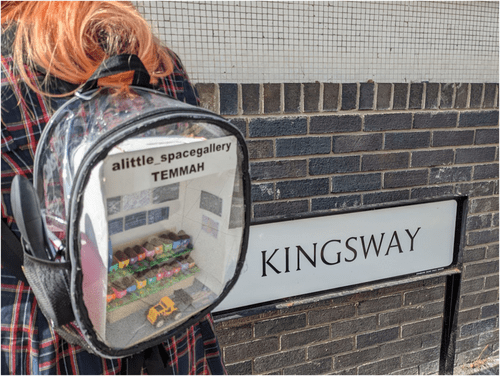
The artist TEMMAH curated her transparent backpack A Little Space Gallery with objects which signified urban renewal. These included tiny, reproduced copies of newspaper articles from 1969, alongside contemporary maps, a small digger, and colourful ceramic terraced houses. I walked around Newport with TEMMAH, where the mobile galley became a starting point for dialogue for people.
The project concluded with a 22-minute film on YouTube. This offers a visual and sonic record of the place itself, performances being practiced and includes some interactions with the public as they reflect on this place changing over half a century previously.
Why geography can help urban renewal efforts now
Much of the urban renewal in post-war Britain was disruptive and involved huge amounts of resource. During the 1980s and 1990s mistakes from previous decades were acknowledged and town and city centres received much less state support. Policy changed during the early 2000s with an urban renaissance championed by architect Richard Rogers. This contributed to bringing many residents back to city centres.
Places in the 2020s face different current and future pressures. In Newport’s case, a new shopping centre opened in 2015 and included a Debenhams department store that closed less than six years later. Rather than a localised issue this was due to a 243-year-old company going out of business. Many other stores across the UK have closed and there is a lot of space looking for a new purpose.
The Area paper show how to make planning histories more accessible, resonant and open to critique. Oral histories, contemporary plans, and other archives can be co-produced as site-responsive performances, films and other engaging materials. For example, Newcastle City Futures helped the public to explore complex and often contested planning history of Newcastle.
People have dealt with significant upheaval within living memory. We need to find ways for the public to be involved with planning and therefore imagine future solutions. There is much to be gained from sharing personal stories and to remind ourselves that compromise will happen. After all, only some elements of the 1950 architectural design for Newport were completely implemented.
About the author: Aled Singleton is a Lecturer in Human Geography at the School of Geography and Planning, Cardiff University. He is interested in long-term emotional and affective attachments to space and place. Aled specialises in walking approaches and qualitative biographical methods.
Suggested further reading
Bonnett, A., & Alexander, C. (2013). Mobile nostalgias: Connecting visions of the urban past, present and future amongst ex‐residents. Transactions of the Institute of British Geographers. Available from https://doi.org/10.1111/j.1475-5661.2012.00531.x
Phelps, N. A., & Tewdwr‐Jones, M. (2008). If geography is anything, maybe it’s planning’s alter ego? Reflections on policy relevance in two disciplines concerned with place and space. Transactions of the Institute of British Geographers. Available from https://doi.org/10.1111/j.1475-5661.2008.00315.x
Singleton, A., Brookes, E., & Slatter, R. (2025). Participatory collaborations between geographers and performance artists: Taking urban renewal histories to the street. Area, Available from https://doi.org/10.1111/area.70052
How to cite
Singleton, A. (2025, October) What participatory geographers can contribute to studying urban renewal over the long term. Geography Directions. https://doi.org/10.55203/LPCQ2931
 Geography Directions