

By Jacob Ankamah, University of Galway
This piece is based on a recent article published in Geo: Geography and Environment (2025), available via https://doi.org/10.1002/geo2.70017
When oil was discovered in commercial quantities off Ghana’s coastline in 2007, it was hailed as a path to national prosperity. However, for thousands of coastal fishing households, the reality has been quite different.
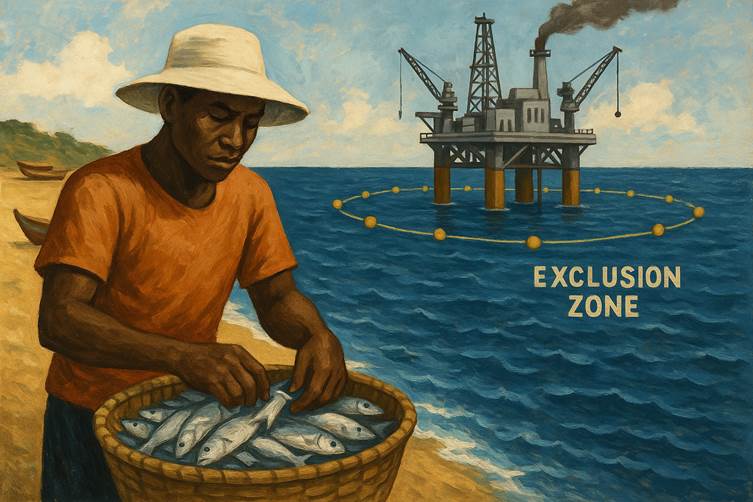
In Ghana’s Western Region, large offshore areas near oil installations are now restricted to fishing (access ban). These fishing bans have transformed open marine commons into extractive zones, disrupting traditional livelihoods and displacing coastal economies. Our recent study explores how this dynamic has reshaped poverty and income diversification among fishers in three coastal communities: Cape Three Points, Akwidaa, and Akatachi.

From ocean access to exclusion zones
Fisherfolk in Ghana have long depended on marine resources for food security, income, and cultural identity. However, with oil extraction, spatial access to the sea has been redefined by exclusion. Large radii around rigs are off-limits for safety reasons, yet ironically, these areas attract marine life due to artificial lighting, concentrating fish stocks that are inaccessible to fishers. This restriction not only reduces daily catches but also increases operating costs and threatens long-term livelihood security.
We explore this paradox through the lens of socio-economic, environmental geography and political economy. We ask a critical question: “how do coastal households adapt when their primary economic activity is disrupted by national development priorities?”
This leads to three broader questions that frame the dilemmas facing marine policy in resource-rich regions like Ghana:
Q1: Should the pursuit of economic growth come at the expense of traditional fishing livelihoods?
Q2: Should policy focus more on alleviating poverty and safeguarding the environment?
Q3: Can strategies be designed to achieve both prosperity and environmental sustainability?
As we show in this study, many households are forced to consider alternative livelihood strategies, and here, the idea of income diversification becomes central.
Marine spatial governance as a new face of the resource curse
We applied the resource curse hypothesis as a conceptual lens, the idea that nations rich in natural resources often experience slower growth, inequality, or even rising poverty. Our findings suggest that the curse is not only national or economic, but also spatial. Marine exclusion zones, imposed by oil consortia and sanctioned by the state, become geographies of dispossession.
This is more than an economic problem; it’s a question of marine governance and who controls space. Coastal residents, already on the economic margins, find their physical and economic access to the ocean curtailed. The resulting spatial injustice underscores why geographical expertise is crucial in debates over resource development.

What the data say
We surveyed 215 fishing households in the study communities, collecting data on income sources, assets, savings, poverty levels, and perceptions of oil-related restrictions. By using the World Bank’s standard tools for measuring poverty, we assessed both the poverty incidence and how varied the sources of their income were (income diversification).
Key findings:
- Poverty incidence was significantly higher among households relying solely on fishing.
- Households engaged in multiple income-generating activities, including farming, petty trade, and artisanal services, had lower poverty levels.
- Factors that positively influenced diversification included access to credit, extension services, asset ownership, and perceived impact from the fishing ban.
- Interestingly, being affected by fishing restrictions increased the likelihood of seeking other income sources, suggesting a reactive adaptation strategy.
Livelihood diversification: a buffer against poverty
Our results affirm the value of diversification as a resilience strategy. Households that combined fishing with farming and non-farming activities fared better in terms of poverty metrics. However, diversification is not simply a personal choice; it’s shaped by geography, governance, and access to enabling institutions (credit, skills, markets).
This has implications for both policy and planning:
- Extension programs can be tailored to help fishers gain skills in alternative sectors.
- Savings and credit schemes should be expanded to support livelihood transitions.
- Spatial planning policies must consider the trade-offs between extractive industries and traditional coastal economies.
From local insights to global lessons
Ghana’s experience is not unique. Across the Global South, small-scale fishers are often displaced by large-scale resource extraction, whether it’s oil, aquaculture, or marine conservation zones. These processes reshape access to space, income, and rights, creating new forms of exclusion.
Our study contributes to broader debates in political ecology and marine spatial planning. It shows how macro-level development agendas like energy security and export revenue can produce micro-level livelihood disruptions, often without adequate compensation or alternative support structures.
Policy insights
- Marine spatial exclusions (e.g. oil rig bans, fishing restrictions) can exacerbate poverty when they displace traditional livelihoods without offering alternatives.
- Income diversification is a significant buffer, but it requires institutional support and access to resources.
- The resource curse is also spatial, manifesting in how marine space is governed, accessed, and contested.
- Policymakers must adopt holistic marine governance approaches that centre the voices of local communities in decision-making.
About the authors:
Jacob Ankamah is a PhD. Economics researcher at the Socio-Economic Marine Research Unit (SEMRU), J. E. Cairnes School of Business and Economics, University of Galway, Ireland. His research areas focus on the “Economics of MPAs”, applying econometric modelling and machine learning algorithms to examine the socio-economic and environmental dimensions of non-market valuation of natural capital. Prior to his PhD, Jacob served as a Junior Research Fellow at the European Institute of Policy Research and Human Rights in Germany, contributing to a project on energy consumption efficiency in oil-producing African countries.
Akwasi Mensah-Bonsu (PhD) is an Associate Professor at the University of Ghana, Legon. He earned his PhD in Development Economics from Vrije Universiteit Amsterdam in 2003. His research interests span development economics, agricultural policy analysis, resource use efficiency modelling, cost-benefit analysis, and the design and evaluation of environmental projects. He has led and collaborated on numerous research projects for national and international organisations, including Ghana’s Ministry of Food and Agriculture, the Food and Agriculture Organisation (FAO), DANIDA, UNDP, NEPAD, and ICIPE.
Wayo Seini (PhD) is a former Professor at the University of Ghana-Legon, with a distinguished career in agricultural economics, public policy, and national governance. He served as a Member of Parliament for the Tamale Central Constituency (2005) and held senior roles in major political parties (NDC & NPP) in Ghana. His work bridges academia and policymaking, with a focus on agricultural policy and development. He currently serves as Chair of the Governing Council of the UDS.
Suggested further reading
Awoa, P. A., Yana, A. G. N., Efogo, F. O., & Ondoa, H. A. (2024). Africa’s resource curse: The key role of property rights. Resources Policy. Available from: https://doi.org/10.1016/j.resourpol.2024.104929.
Mensah-Bonsu, A., Ankamah, J. & Seini, W. (2025). Poverty alleviation in fishing communities affected by oil production in Ghana: Does income diversification matter? Geo: Geography and Environment. Available from: https://doi.org/10.1002/geo2.70017.
Montana, J. & Hartman Davies, O. (2024) Large-scale marine protected areas and imaginaries of progress in ocean governance. Geo: Geography and Environment. Available from: https://doi.org/10.1002/geo2.155
Owusu, B. (2018). ‘Doomed by the ‘resource curse? ‘Fish and oil conflicts in the Western Gulf of Guinea, Ghana. Development. Available from: https://doi.org/10.1057/s41301-018-0189-y.
Paniagua, P., & Rayamajhee, V. (2024). Governing the global fisheries commons. Marine Policy. Available from: https://doi.org/10.1016/j.marpol.2024.106182.
How to cite
Ankamah. J. (2025, September) Oil, exclusion, and livelihoods in Ghana’s offshore fisheries. Geography Directions. https://doi.org/10.55203/BXNN6287
 Geography Directions