

By Suranjan Majumder, University of North Bengal
An ‘everyday’ geography we often fail to acknowledge
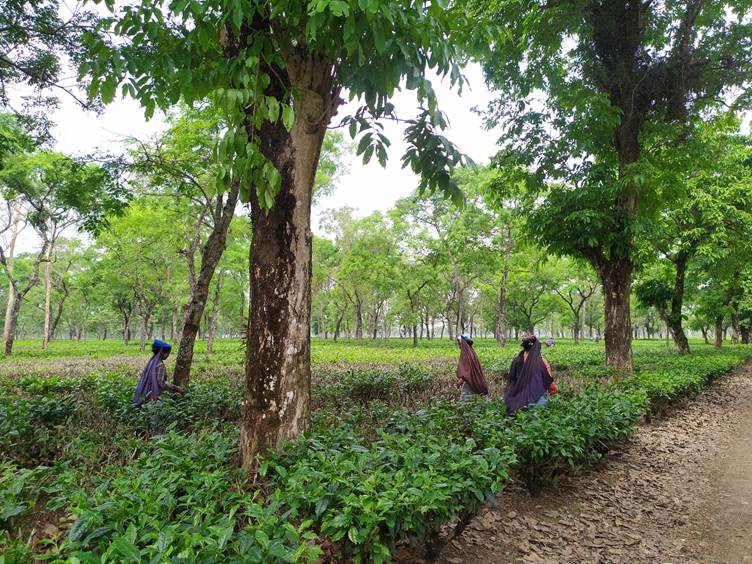
A central question in “spatial justice” today is how and why certain geographies continue to experience structural neglect, even as dominant development narratives promote the ideal of inclusive progress. This concern is particularly acute for policy planners across the Global South, especially in regions like India’s Dooars, where vast tea plantations dominate the landscape and shape both the ecology and economy. Despite decades of welfare interventions, these plantation zones, characterised by monoculture estates, labor lines, and deep-rooted social hierarchies, continue to exhibit persistent developmental stagnation. These areas, often dismissed as “peripheral” or “neglected spaces,” are in fact profound examples of “backward geographies,” a notion that challenges the conventional understanding of underdevelopment. In these tea estates, colonial hangover has not merely passed, it has hardened inequalities and deepened exclusions, embedding a history of marginalisation that remains largely absent from mainstream development discourse.
Against this backdrop, my recent study, published in Area explores and challenges the taken-for-granted silence surrounding tea plantation enclaves. It does so by theorizing the concept of ‘backward geographies’ not as passive underdevelopment, but as actively produced spatial exclusions. These are places not simply left behind, but deliberately kept behind. In this regard, the spaces of plantattionscape where deprivation is not accidental. Such spaces are systematically produced through colonial legacies, neoliberal neglect, and state indifference. This research is grounded in ethnographic fieldwork among the Oraon tribe, a predominantly Adivasi (Indigenous) group, many of whom have worked in the plantations for generations. These tea gardens are not simply sites of economic activity. Rather, they are politically managed zones of exclusion, where livelihood options are narrow, public services scarce, and entire communities historically employed as plantation labor remain trapped in cycles of poverty and marginality shaped by colonial legacies and caste-tribe hierarchies.
Within policy and bureaucratic discourse, the term “backward” is often used to designate tribal communities as needing development. However, what if “backwardness” is not inherent to people or places, but constructed through structural processes? The term “backward geographies” extends beyond a mere description of developmental lag. Instead, it serves as a critical lens to interrogate how specific spaces are rendered structurally invisible and institutionally disposable. This “invisibility” is not incidental; rather, it is a deliberate outcome of historical processes rooted in colonization and dispossession, further perpetuated by neoliberal developmental paradigms that prioritize profit and urban expansion at the expense of indigenous labor rights and social welfare. Building on this perspective, I argue that plantation spaces are shaped by colonial legacies, neoliberal development logics, and systemic state neglect, which together produce a landscape where livelihoods remain fragile, voices go unheard, and rights are continually postponed.
Why ‘backwardness’ persists in the plantationscape?
In my study of the Oraon community within the tea plantations of the Dooars region, I argue that backwardness is not an accidental lag in development, but rather an actively maintained spatial condition, produced through historical legacies and contemporary governance failures. More specifically, the persistence of backwardness in the plantationscape emerges from a complex intersection of colonial labour regimes, landlessness, and institutional invisibility, all of which continue to shape the everyday realities of plantation labourers. Drawing from ethnographic fieldwork, I show how the paradox of structural dependency on plantation work continues across generations. This form of dependency refers to a condition in which entire communities are compelled to rely on a single, often exploitative, industry not by choice but because of enduring structural barriers that restrict access to alternative livelihoods. These barriers include the lack of land ownership, absence of auxiliary employment opportunities, limited access to credit and vocational training, and minimal political representation. As a result, plantation labor becomes not merely a job but an inherited condition shaped by systemic exclusion and a chronic absence of viable alternatives.
Importantly, these are not naturally marginal spaces. On the contrary, they are politically curated zones of exclusion, where state welfare is fragmented, infrastructure is deliberately withheld, and community voices are structurally silenced. Against this backdrop, the conceptual framing of ‘backward geographies’ offers a way to understand this condition not as passive underdevelopment, but as a geography of managed invisibility in which mono-livelihood dependency, gendered constraints, and spatial isolation converge to institutionalize “unfreedom.” Thus, backwardness persists because it is embedded in both space and policy, sustained by development models that extract labour while denying dignity, autonomy, and the right to a better future.
Mono-livelihood dependency: no escape from the tea garden
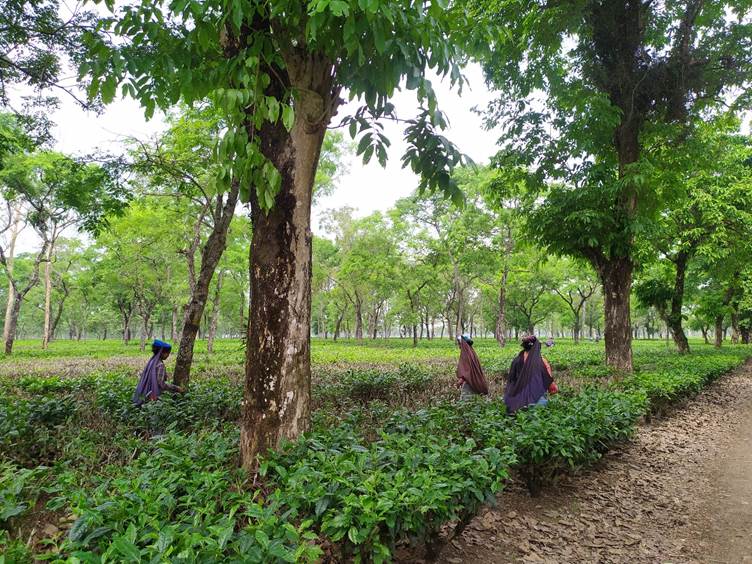
In this context, Tea plantations, for more than one-third proportion of households, remain the sole livelihood option. Due to a lack of land, no access to formal credit, and minimal state support, the community is trapped in what I refer to as the “inertia of intergenerational survival.” Drawing upon Amartya Sen’s concept of “development as freedom,” this study argues that the denial of access to basic services, such as clean drinking water, safe sanitation, healthcare, and education, constitutes a form of structural unfreedom.
Crucially, the absence of alternative employment, vocational training, or land rights creates a near-feudal dependency. Although government schemes like Kanyashree and Lakshmir Bhandar, livelihood diversification remains more myth than reality. Even when individuals tried small-scale farming or opened tiny shops, lack of market access, transportation, and financial support pushed them back into plantation labour. In this regard, dependency here is “not a choice,” it is a condition produced and reinforced by spatial and institutional neglect.
Reinforcing this, Survey data reveals that 74.7 percent of Oraon households lack adequate sanitation facilities. Only 19.72 percent have access to protected drinking water sources, figures that frankly illustrate both geographic and infrastructural inequities. Moreover, these vulnerabilities are exacerbated by the widespread closure of tea gardens, which has intensified poverty, heightened food insecurity, and even led to reported starvation deaths among affected workers. Gender dynamics further compound these challenges. Women in the plantation economy face a “double burden,” experiencing both low wages and limited decision-making power. Despite this, they often spearhead survival strategies.
Geographic isolation profoundly exacerbates these challenges, severely restricting access to essential services and infrastructure. For instance, a middle-aged male respondent lamented the lack of transportation for the sick, while a female family member highlighted the absence of nearby high schools, forcing daughters to abandon their education. These narratives underscore how spatial isolation not only hinders access to fundamental services but also entrenches dependency on exploitative economic systems, particularly plantation work.
Rethinking development: toward a geography of justice
In the era of the Anthropocene, which refers to the current geological epoch in which human activity has become the dominant force shaping the Earth’s climate and ecosystems, development compels a fundamental rethinking—not as a linear process of economic growth, but as a struggle for recognition, redistribution, and rights in spaces long relegated to the margins. In the context of the Dooars tea plantations, development initiatives frequently remain confined to bureaucratic records, while ethical imperatives and transformative outcomes remain absent. Significantly, the lived realities of the Oraon community expose the limitations of dominant development approaches that treat backwardness as a technical problem to be corrected, rather than a “structural injustice” to be dismantled.
Building on the lens of ‘backward geographies’, I argue for a geography of justice that centers the capabilities, aspirations, and entitlements of marginalized communities rather than framing them through deficit-driven categories. Consequently, development must move beyond income indicators and scheme coverage to address the political architectures of exclusion: lack of land rights, denial of education, poor access to healthcare, and the invisibility of labour. In this light, a geography of justice requires re-spatializing state accountability, recognizing subaltern agency, and challenging the extractive developmental logics that continue to normalise mono-livelihood dependency.
About the author: Suranjan Majumder is a doctoral researcher in the Department of Geography & Applied Geography at the University of North Bengal, India. His work engages with critical development geography, spatial justice, and subaltern livelihoods, with a particular focus on plantation economies in eastern India. Drawing on ethnographic and spatial methodologies, his research foregrounds the existed local geographies of subaltern communities and challenges dominant narratives of development.
Suggested further reading
Barua, M. (2016). Nonhuman labour, encounter value, spectacular accumulation: the geographies of a lively commodity. Transactions of the Institute of British Geographers. Available from: https://doi.org/10.1111/tran.12170
Barua, M. (2022). PlantationOcene: A vegetal Geography. Annals of the American Association of Geographers. Available from: https://doi.org/10.1080/24694452.2022.2094326
Ghosh, B. (2014). Vulnerability, Forced Migration and Trafficking in Children and Women: A Field View from the Plantation Industry in West Bengal. Economic and Political Weekly. Available from: http://www.jstor.org/stable/24480169
Majumder, S. (2025b). ‘Backward geographies’: Contested lives and livelihoods in the tea plantation enclaves of South Asia. Area. Available from: https://doi.org/10.1111/area.70026
Natarajan, N. (2020). ‘After me, all this is over’: Exploring class‐entangled geographical agency in a shifting climate among tobacco farmers in South India. Area. Available from: https://doi.org/10.1111/area.12693
How to cite
Majumder, S. (2025, July) Why do plantation enclaves (re) produce a geography of backwardness? Geography Directions. https://doi.org/10.55203/GJWG2827
 Geography Directions