

By Jeremy Schmidt, Queen Mary University of London
What role should digital platforms like Minecraft or Pokémon play in geographical education? It may sound trite to say, ‘It depends on who you ask,’ but these platforms are an increasingly important part of pedagogy. For some, virtual worlds allow a kind of fieldwork, and enable forms of accessibility, that the real world does not. Going abroad without carbon emissions, or back in time to the landscape of a Jane Austen novel, for instance, are now possibilities from within classrooms. For others, however, the constraints of these platforms means that, no matter how well intentioned their use, the virtual world within them harbour assumptions about other peoples and places that reinforce problematic—often colonial—ideas.
Amid these debates, governments are also increasingly active in using Minecraft and similar platforms for public geoscience. In the Canadian province of Alberta, for instance, the Alberta Geological Survey launched a bespoke extension to Minecraft that allows players to virtually mine bitumen—a form of heavy oil with a viscosity closer to peanut butter than to petrol—in the world’s fourth largest oil reserve. It isn’t the only extension available. You can also dig for dinosaur bones in the world-famous sites near Drumheller. Or, if you’re not the gaming type, you can take 360° tours of virtual landscapes past and present.
In a recent article in Geo: Geography and Environment, I put aside the question of whether these digital platforms themselves are good or bad, friend or foe to geographical education. Instead, I asked a different question: where and how did the data used to create the virtual world for mining bitumen came from? As it turns out, that data was collected after residents in the Peace River region complained about environmental health concerns ranging from headaches to nausea. Some of these health impacts were severe enough to force people from their homes and affected farm animals and pets too. In response, the government initiated a modelling study as one part of its response to citizens, and that study located the source of foul odours in one geologic layer that made bitumen extraction in Peace River unique. In other words, the Minecraft data was directly derived from extraction and its harmful effects on local communities.
By tracing the data used to create Alberta’s Minecraft extension I sought a new way to think about the relationships of digital geographies and the environment. There are many aspects to these relationships that are prominent in media and scholarship: the large data centres now using vast quantities of water to cool their servers all while slurping up energy at unsustainable rates, for instance. But amid those concerns there are others not to be overlooked. The data for public geoscience comes from somewhere—places with histories and infrastructures for collecting, holding, and distributing knowledge. In the Alberta case, the source of geoscientific knowledge is literally extracted from the Earth owing to the province’s long-standing requirement for oil companies to deposit drilling data with the Alberta Geological Survey.
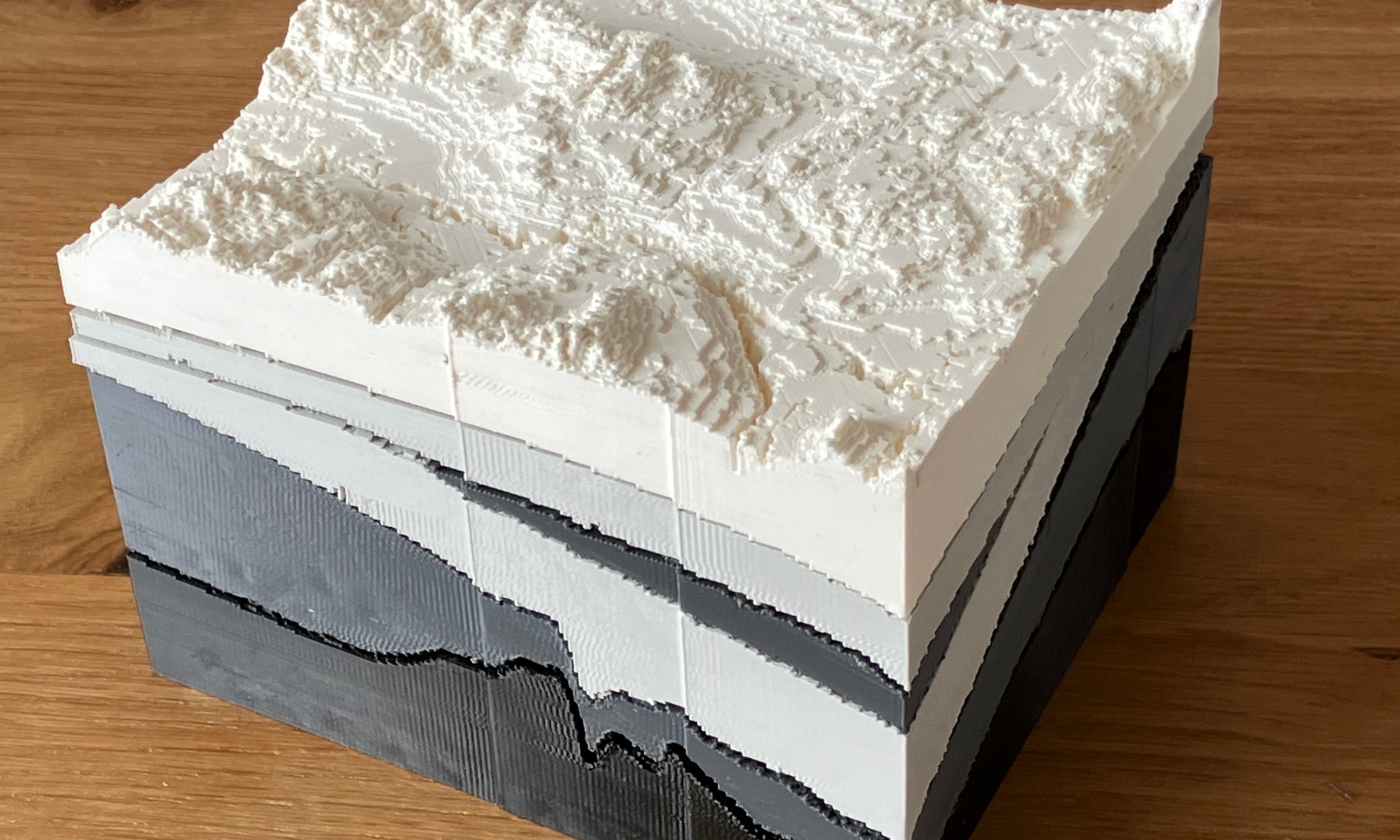
So, should we teach with Minecraft? This isn’t the kind of yes/no question it might seem at first. It is instead a good question to think with owing to how it can prompt reflection on the practices through which geographic knowledge is collected, maintained, and used in public geoscience. I took the Minecraft file over to our engineering labs, for instance, to have it 3D printed to think through other material forms digital data may take (pictured above). It comes apart like a loose stratigraphic puzzle to show something of past paleogeographies. In so doing, it also opens questions with colleagues and students about the relationships of data to the forms of Indigenous dispossession that attend geoscientific knowledge in Alberta.
My hope with this short post is that those who are looking for a way to connect students with different digital environments might find in my article a way to think across these different issues—from environmental health to new digital geographies—in a way that offer resources to participate critically in virtual worlds that map on to those lived elsewhere.
About the author: Jeremy Schmidt is a Senior Lecturer of Environmental Geography at Queen Mary University of London. He is a co-editor of Area, published by the Royal Geographical Society. His research focuses on social dimensions of human impacts on the Earth system. He is the author of Water: Abundance, Scarcity, and Security in the Age of Humanity (New York University Press). His new book, Landlocked: Water, Energy, and Planetary Politics in Alberta, will be published by the University of Chicago Press in 2026.
Suggested further reading
López López, L.L., de Wildt, L. & Moodie, N. (2019) ‘I don’t think you’re going to have any aborigines in your world’: Minecrafting terra nullius. British Journal of Sociology of Education. Available from: https://doi.org/10.1080/01425692.2019.1640596
Miner, J.D. (2022) Critical Protocols in Indigenous Gamespace. Games and Culture. Available from: https://doi.org/10.1177/15554120211005366
Rader, E. et al. (2021) Pandemic Minecrafting: an analysis of the perceptions of and lessons learned from a gamified virtual geology field camp. Geoscience Communications. Available from: https://doi.org/10.5194/gc-4-475-2021
How to cite
Schmidt, J. (2025, June) Minecraft as Public Geoscience? Between new digital geographies and the data of dispossession. Geography Directions. Available from: https://doi.org/10.55203/ZLOR6610
 Geography Directions