

By Ewan Woodley, University of Exeter
The challenges of moving towards low-carbon travel for geography field courses
Field courses are a key component of learning in geography. However, for a quarter of a century, flying has been a hallmark of these activities, with ‘exotic’, often long-haul destinations featuring extensively in university marketing. Despite the long-known relationship between air travel emissions and human-induced climate change, these activities have been justified in all sorts of ways, from student demand for such experiences, the educational value of visiting specific places, to the necessary development of practical skills. Reassuringly, a 2024 survey by the Royal Geography Society (with the Institute of British Geographers) found that many geography departments are starting to move away from flying in favour of shorter distance destinations via low-carbon rail or coach transport. However, recent national level work (Woodley et al., 2024) identified two significant and urgent issues for universities to address.
The popularity of flying in people’s personal lives
Firstly, the global demand for air travel is predicted to double by 2040. Within the UK, the Civil Aviation Authority reported that 18-34 year-olds are leading a post-COVID aviation revival, with 65% of this age group taking at least one flight in 2023. At the same time, many tourism providers are using carefully choreographed packages to market affordable holidays that are only reachable by plane. Crucially, all of this is happening in an environment where there are few prospects for developments in policy or technology to substantially reduce carbon emissions. Whilst some students do not fly for a variety of reasons (health conditions or disability, financial costs, environmental consciousness), I argue that air travel as an increasingly popular behaviour, even an expectation, presents a challenge for universities in promoting low-carbon travel practices (such as rail travel) to students.
Academics should lead by example by minimising flying for work
Secondly, the challenge of flying as a ‘normal’ activity is exacerbated by the popularity of this mode of work travel among academic staff at universities. To illustrate the scale of this problem, in 2019, the University of Exeter’s travel carbon emissions were at least 21% of institution’s total, excluding international student travel to and from the UK. Research at the Université de Montréal published in 2019 revealed that professors travel more than 33,000 km/person per year. The reasons for the continued use of air travel in universities are varied and sometimes complex, including time constraints, cost implications, personal career development and considerations regarding Equality, Diversity and Inclusion. Yet importantly, this continued use of air travel is the ‘elephant in the room’: I argue that we cannot expect students to move away from flying in favour of low-carbon travel options unless academics (and other staff) can demonstrate that meaningful efforts are being made to minimise flying for work, primarily for research. For this to happen, academics and institutions must demonstrate stronger leadership in reshaping professional practices to reduce carbon emissions. This may involve shifting expectations on travel to conferences and meetings, as well as field courses, stricter enforcement of sustainable travel for destinations reachable within 24 hours, and infrastructures that effectively support staff in these processes.
Establishing low-carbon travel for geography field courses
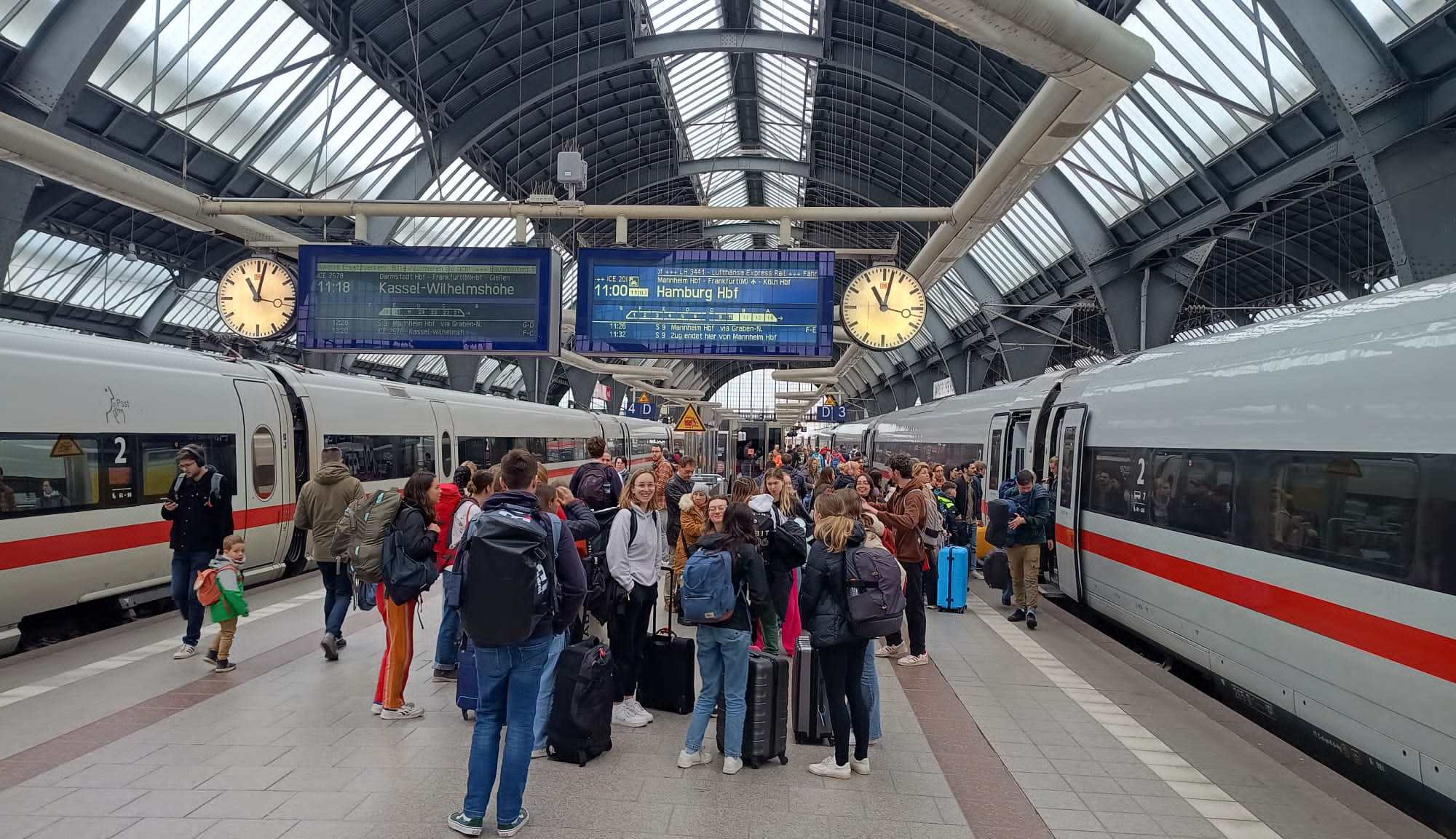
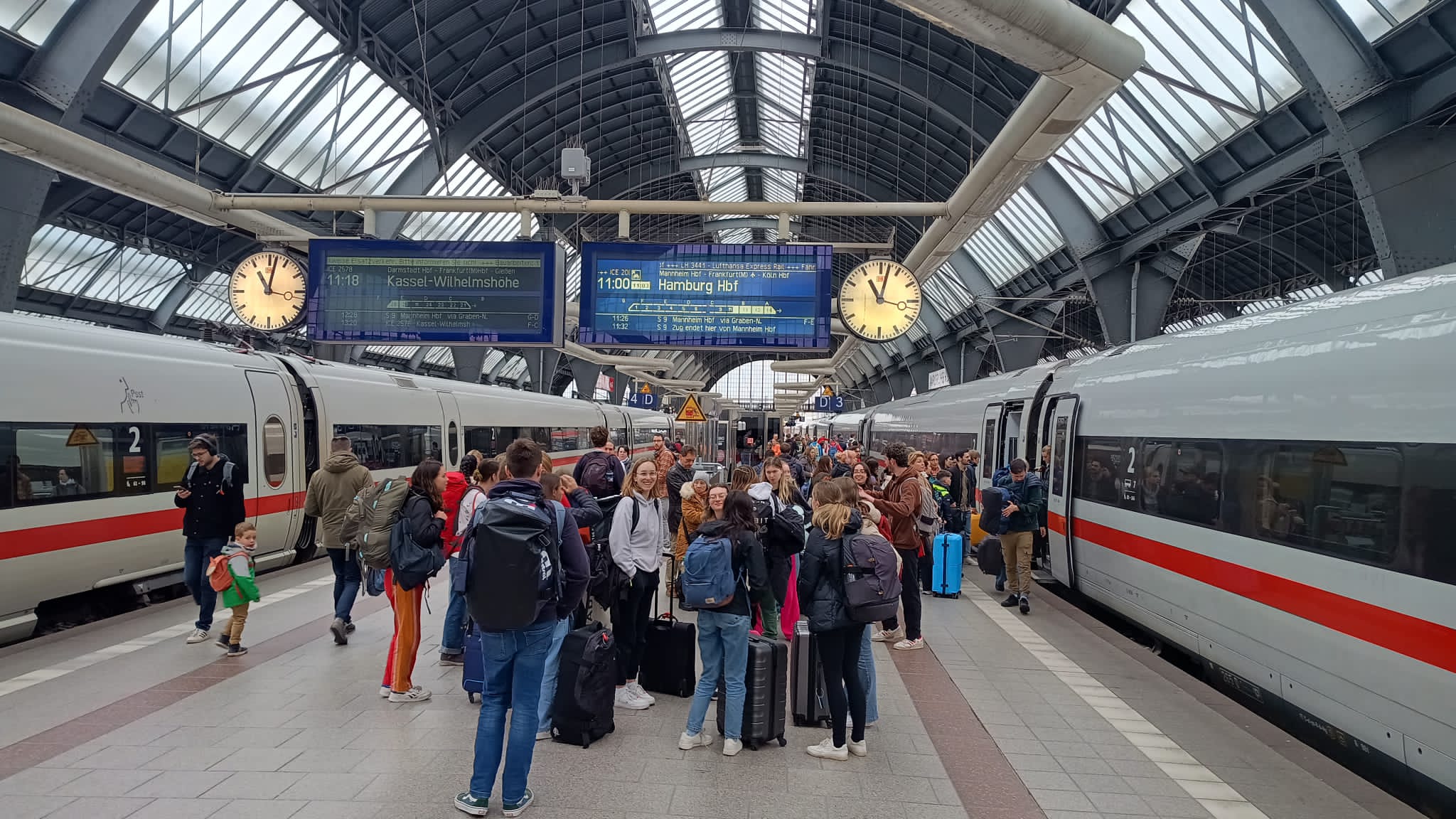
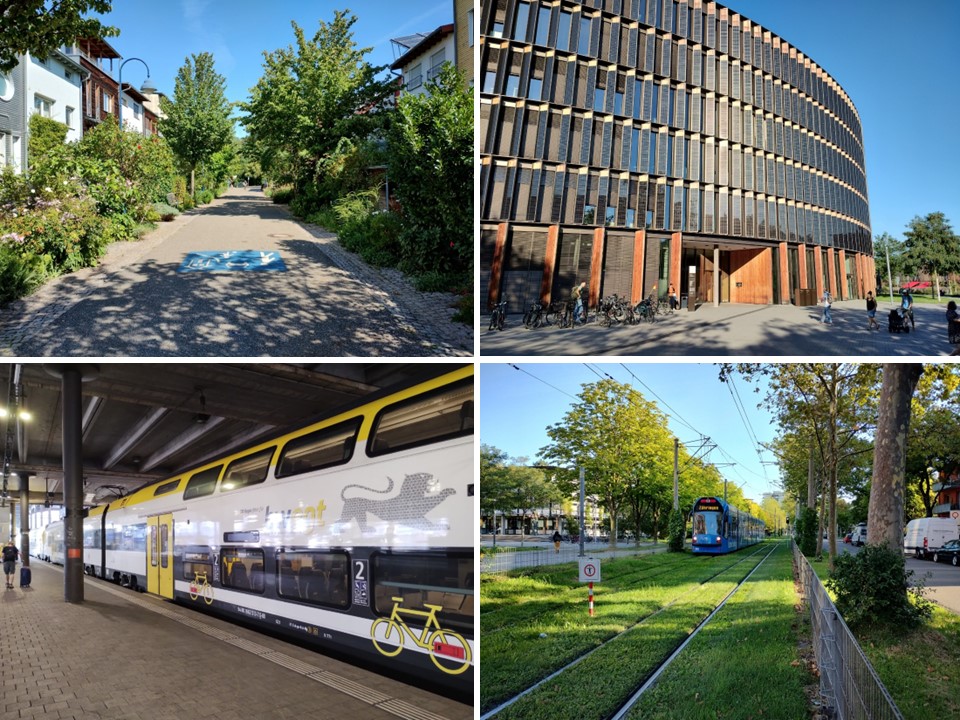
The good news is that there are examples of sustainable, reasonably priced, high-speed rail travel being adopted for group-based travel across some UK Geography departments. An example is the Environmental Futures Field Course (University of Exeter) to Freiburg in Germany, known for sustainable urban development, that provides students with an opportunity (cost included in the tuition fee) to study green urban infrastructure such as public transport, high-density living, and green energy to think imaginatively about future ways of living (Figures 1 and 2). Crucially, in enabling students to experience high-speed rail travel, opportunities such as this not only have the potential to be personally transformational, but also help students in understanding conversations about how we might live and move in future low-carbon societies. In this respect, the rail journey itself can act as an important component of the learning process, shaping how we think about travel in relation to time and distance. Yet, to realise a more widespread adoption of rail travel, universities need to provide an infrastructure that enables staff to make this change, including support with logistics and bookings, and developing experience and confidence in travelling differently. At the same time, it is important to note that exciting developments in virtual field-based learning are increasingly providing opportunities for students to learn about distant or inaccessible environments with little carbon impact.
Conclusion
If we are to move from a dominance of education ‘about’ climate change to education ‘for’ positive societal transformation, universities must exercise greater leadership in pursuing three urgent needs. Firstly, students across subjects must be provided with opportunities to learn about, reflect on, and openly discuss how the current political-economic doctrine shapes the way we view and manage climate change – as a technical problem to be ‘fixed’. An important part of this learning should encourage students’ imagination and creativity in thinking about alternative futures for societies that draw our attention to the social challenges and opportunities of climate change. Secondly, universities must reflect on the extent to which their stated environmental values, set out in climate emergency declarations and carbon reduction goals, and promoted in university teaching and learning, are reflected in how education is practiced. Thirdly, in developing a stronger approach to de-carbonising travel in universities, institutions need to ensure that their policies are equitable and promote low-carbon travel in an accessible way, recognising the need to be inclusive in our decision making. Tangible transformations can be achieved, but higher education institutions must demonstrate stronger leadership in turning declarations of intent into meaningful climate action.
About the author: Ewan Woodley is an Associate Professor of Geography at the University of Exeter and a Principal Fellow of the Higher Education Academy. His work focuses on the role of social learning in providing new, and often valuable, perspectives on environmental issues that are not always accessible through scientific practices alone. He is the University of Exeter co-Advocate for Sustainability Education and is committed to supporting institutions in making meaningful transformations to address climate and environmental crises. This is reflected in Ewan’s teaching on Managing the Climate Emergency and the Environmental Futures Field Course.
Suggested further reading
Arsenault, J., Talbot, J., Boustani, L., Gonzalès, R., & Manaugh, K. (2019). The environmental footprint of academic and student mobility in a large research-oriented university. Environmental Research Letters. Available from: https://doi.org/10.1088/1748-9326/ab33e6
Barr, S. & Shaw, G. (2024) Addicted to flying: Why it’s so hard to kick this carbon-intensive habit. The Academic. Available from: https://theacademic.com/why-its-so-hard-to-kick-this-carbon-intensive-habit/ [Accessed 12th June 2024].
Bjørkdahl, K., Duharte, F. & Santiago, A. (2022) Academic flying and the means of communication. Singapore: Springer Nature, p. 365. Available from: https://doi.org/10.1007/978-981-16-4911-0
CAA. (2024) Young people leading post-COVID aviation revival, UK Civil Aviation Authority finds. UK Civil Aviation Authority. Available from: https://www.caa.co.uk/newsroom/news/young-people-leading-post-covid-aviation-revival-uk-civil-aviation-authority-finds/ [Accessed 16th June 2024].
Higham, J. & Font, X. (2020) Decarbonising academia: Confronting our climate hypocrisy. Journal of Sustainable Tourism. Available from: https://doi.org/10.1080/09669582.2019.1695132
Hopkins, R. (2019). From what is to what if: unleashing the power of imagination to create the future we want. White River Junction, Chelsea Green Publishing. https://www.robhopkins.net/the-book/ [Accessed 20th November 2024].
IATA. (2023) Global outlook for air transport: Highly resilient, less robust. International Air Transport Association Report. Available from: https://www.iata.org/en/iata-repository/publications/economic-reports/global-outlook-for-air-transport—-june-2023/ [Accessed 18 May 2024].
University of Exeter Environment and Climate Emergency Working Group White Paper (2019). Available from: Full-EnvClimE-White-Paper-11_11_19.pdf [Accessed 6th November 2024].
Whitmarsh, L. 2024. Why is behaviour change a better bet than techno-optimism? Scientists for Global Responsibility. Available from: https://www.sgr.org.uk/resources/why-behaviour-change-better-bet-techno-optimism. [Accessed 20th November 2024].
Woodley, E., Barr, S., Batty, L., Bickerstaff, K., Darvill, C., Ferdous, R., … & Yorke, L. (2024). The future of geography field course pedagogy in UK higher education. Geo: Geography and Environment. Available from: https://doi.org/10.1002/geo2.158
How to Cite
Woodley, E. (2025, January) From plane to train: promoting low-carbon travel for geography field courses in UK higher education. Geography Directions. https://doi.org/10.55203/LJNQ3502
 Geography Directions