


By the States of Precarity Team:, Johanne Bruun, Rachel Colls, James Esson, Peter Forman, Anna Jackman, Rachael Squire (corresponding author)
“Because geography is about attention to difference and the uneveness of power and agency and geographers are often shouting about what transpires in their sites of research, without bringing those same standards and ethics to their own places of work” (Survey participant, 2023)
The situation
Fixed term contracts have become increasingly common in Geography Departments across the UK. Over one third of all UK academic staff are employed on such contracts, with an increase in the use of zero hours and hourly paid contracts since 2019/20.
A fixed term contract does not only dictate the terms of employment. It directly impacts the ability of colleagues to feel at home, to feel able to plan a family, to access healthcare and live health-ful lives, to establish relationships, or simply to have the ability to plant some flowers in your garden in the knowledge that you’ll see them grow. We might refer to such conditions as precarious – as ‘employment conditions that do not enable the living of a fulfilling life’ and which prevent planning for the future (survey participant 2023).
The research
States of Precarity is a research project, funded by the Royal Geographical Society (with IBG) and Antipode, that explores precarious working conditions in UK HE Geography as they manifest across different institutions and are experienced and felt across career stages.
A discipline-wide survey was conducted as part of the project, with 365 respondents. Fixed term contracts have unsurprisingly emerged as a key challenge and area of significant concern. Whilst the project will explore the wider complexities and temporalities of precarity in geography elsewhere, this blog post seeks to directly engage with a key issue highlighted in the survey responses.
Our preliminary analysis clearly demonstrates the challenges that colleagues on fixed term contracts face, but participants also highlighted the lack of understanding, and recognition, of these challenges among their colleagues. Survey responses described how colleagues – particularly senior colleagues – were often unaware or ignorant of the extensive use of fixed term contracts and the wide-ranging personal and professional implications of those contractual terms. For example, participants reported that there was little awareness of the difficulties of moving to a new city or country while on a short-term contract; and that for those on visas, there is not ‘much understanding of the unique challenges foreigners may face while living abroad’ (survey participant 2023).
Participants also reported feeling that their mentors or managers did not understand, or, at times, did not care about the effects of their employment conditions. This manifested in a number of ways, from being told by a mentor not to bring emotion into their experiences of being on a fixed term contract, to descriptions of feeling overworked, exploited, dismissed, or invisible. One participant noted that they felt that no one noticed when they arrived in their department at the start of their contract or when they left at the end.
In light of a limited scope for sector-wide structural change, fixed term contracts are not going anywhere. As a community of academics, we must therefore ask what can be done to ensure that colleagues on fixed term contracts do not bear the brunt of the crises in HE, and how we can work toward progressive changes to cultivate caring and care-full cultures in the neoliberal academy.
In responses to our survey, we found important and inspiring examples of best practice in response to these questions. This includes colleagues supporting and investing in the career development of more junior staff through mentoring or, more informally, through taking the time to listen. As one of our respondents stated:
‘I will never forget the senior lecturer working on employment relations who made a point of taking out each new post-doc to lunch. She paid for (it) and talked about the ECRs research, how they were getting on and their plans.’
Participants also reported the importance of having an ‘academic champion’, of having a formal departmental induction, and of being invited to participate in the full range of departmental life. These specific actions were cited as making their experiences of fixed term contracts more positive.
However, experiences of these forms of good practice are not universal. Generating a positive and supportive environment all too often relies on a small number of generous colleagues actively investing their time and energy to address challenges produced by fixed term contracts.
Resources for change
Whilst the neoliberal academy is a relentlessly challenging context, our research has found that there is much that can be done, both individually and collectively, to create working environments that are more equitable, supportive, and aware of the needs and contexts of fixed term colleagues. Whilst we cannot take full responsibility for the endemic structural problems within UK Higher Education, nor can we cede responsibility for caring about our colleagues. As one participant noted, it is all too easy when in a salaried, permanent position to ‘forget how stressful and detached fixed term contract work can be’. Our participants stated that more explicit discussion about the challenges faced by those employed on fixed term contracts in academia would be a positive step forward in addressing a lack of awareness.
In response, as a first step, we have generated a set of resources designed to represent and share the experiences and voices of survey participants as well provide suggestions for how colleagues and departments can better support fixed term colleagues.
The first set of resources are three posters, designed by Zoe Ayres, for use in UK geography departments. Our intention is that they help to raise awareness and give visibility to this issue whilst also reminding colleagues on permanent contracts about the challenges that can accompany temporary employment. Please print these off, put them on poster boards, and talk about them in staff meetings and other forums.
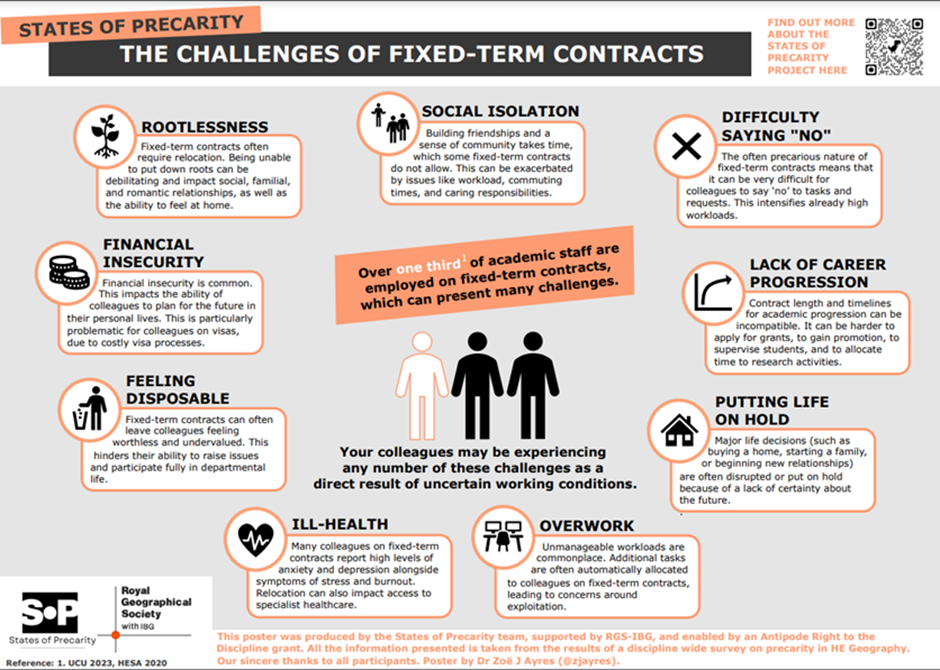
The first poster (see above) outlines some of these challenges that colleagues on fixed term contracts experience. The second highlights what individuals and departments can do to engage with and respond to these challenges, and the third draws attention to how identity and difference can compound and exacerbate colleagues’ experiences of fixed term contracts. The effects of precarity are, of course, not experienced evenly. Each poster is underpinned by the experiences of participants so generously shared through their survey responses.
Alongside this, participants reported that they would like to see more senior colleagues proactively engaging with the challenges of fixed term contracts. We are currently developing a set of best practice matrices to enable departments to proactively engage with this issue. We have also produced three adaptable template letters that colleagues across career stages can use to lobby their institutions and departments to request, and, we hope, enact meaningful changes. The focus of each letter relates directly to issues raised by survey participants, including requesting access to the institutional email account after a contract ends, securing a minimum term of employment of at least 12 months, and ensuring probation lengths correspond appropriately with length of contract.
All resources are free to access and download on the States of Precarity website.
Geography as a discipline is concerned with power, place, and agency. Such concerns cannot just be the concern of research ‘in the field’ but must be brought to our ‘own places of work’.
About the author: Rachael Squire is a Senior Lecturer in Human Geography at Royal Holloway, University of London. Most recently, she has been working with the States of Precarity team to explore experiences of precarity within academic geography. More broadly, her work, underpinned by feminist geopolitical approaches, explores questions relating to oceans, territory, and Cold War science.
Suggested Further Reading
Hughes, S. M. (2021). “Wait for a permanent contract”: The temporal politics of (in)fertility as an early career researcher. Environment and Planning C: Politics and Space. Available from: https://doi.org/10.1177/2399654421994852
Mason, O., & Megoran, N. (2021). Precarity and dehumanisation in higher education. Learning and Teaching. Available from: https://doi.org/10.3167/latiss.2021.140103.
Pickerill, J. (2024). Challenging neoliberal time: Creating space for radical praxis in geography. Area. Available from: https://doi.org/10.1111/area.12981
How to Cite
Bruun, J., Colls, R., Esson, J., Forman, P., Jackman, J., Squire, R. (2025, January) Resources for change: raising awareness of the challenges of fixed term contracts in geography departments. Geography Directions. https://doi.org/10.55203/EESH7830
 Geography Directions