


By Caroline (Carly) Bagelman, Liverpool Hope University and Jen Bagelman, Newcastle University
Pregnancy apps currently outnumber any other fitness or health app on offer; they are so ubiquitous that over 50% of pregnant people now use one. Despite the well-established fact that at least 1 in 5 pregnancies will end in miscarriage, our research suggests pregnancy apps have not been designed with this loss in mind. Attention to loss is not only lacking on these pregnancy apps but, we argue, actively contributing to silencing pregnancy loss. In framing pregnancy as a straightforward progression towards birth and emphasising self-care practices to mitigate risk, these apps largely erase the reality of loss and deepen feelings of grief and alienation for those who experience it.
A creative & collective approach
Pregnancy+ is the most widely-used pregnancy app in the UK, USA, Germany and an industry leader worldwide. It offers a range of free features such as weekly, interactive 3D animations of the uterus, simulated dopplers and scans as well as articles on everything from sleeping positions to recommended antenatal diets.
We (sisters Carly and Jen) completed ethnographic research into this app during Carly’s own journey through multiple pregnancy losses. Specifically, we mobilised a ‘sister-ethnographic’ approach: one that collectively processes, explores and analyses loss through shared conversation. This resists the hyper-individualising and silencing of loss which has been widely noted as a persistent problem, and which we see traditional auto-ethnographic accounts (emphasising the individual) maintaining rather than upending. While biologically related sisters, we hope this method might be held within wider communities of non-cis, non-biological sisterhoods to address various reproductive justice struggles in their lived expansiveness.
Simulated pregnancies, and the withdrawal of care in pregnancy loss
Through our sister-ethnographic approach, we demonstrate how the range and quality of resources offered by Pregnancy + and fertility apps like it withdraw when loss occurs. The only place to register loss on the app is hidden away like an unsubscribe button on email spam – a technique User Experience (UX) designers refer to as ‘dark patterns’ made to bury undesirable content or functions and boost profitable ones. Once the ‘pregnancy loss’ button is found and selected in the app, all features disappear and the user is left with a barren, unnavigable app with only a few generic articles on miscarriage. Yet, the app continues to have haunting afterlives. The price of the free app is that companies who have purchased your data from Pregnancy+ chase you across different platforms online offering maternity clothes and pregnancy pillows long after one clicks the ‘pregnancy loss’ button because these apps have not implemented a simple mechanism to update advertisers.
In addition to this sense that the user has been both abandoned and followed by the app when loss occurs, our research demonstrates how the digital tool generates a false sense of security in the user. Through its various imaging features noted above, we found Pregnancy+ compellingly simulates ‘normal’ development on screen, and shapes what we refer to as a ‘vicarious pregnancy’ (in which what is presented on screen becomes felt as real, and a pregnancy resulting in birth becomes the assumed outcome). Screens living in palms and pockets displaying an animated foetus (updated each week based on user data to show how ‘your baby’ has developed), starts to feel like a mirror into the womb. The Pregnancy+ user is prompted to choose the foetus’ skin-colour, which goes to deepen this intimacy and imagined realism of the images. The app even encourages sharing the simulated scans, as one might after an actual sonographer appointment. While pregnancy has long been filled with unknowns and doubts, the app’s images (lively and scientific in their presentation) replace the hazy, imagined sense of foetal development with certainty: this is what your foetus looks like right now. This certitude the apps cultivate can make the discovery of pregnancy loss during a real scan an especially destabilising and stark one.
Addressing silences through app annotations
Existing approaches to capturing experiential geographies within digital health spaces, we argue, remain limited. Typically, they focus on design analysis or user surveys, neglecting the nuanced emotional and lived dimensions of engaging with these platforms, especially in moments of loss. To address this gap, we introduce the use of ‘app-annotations,’ which involve an intentionally low-tech technique that can be employed by any app user. App annotations involve printing app screenshots and overlaying them with hand-drawn and written annotations and ephemera. These zine-like annotations serve as interventions into digital space, providing a tactile and embodied perspective on using an app. They provide a way to mess-up the often one-way digital space of apps. See below an example of Carly’s app annotation:
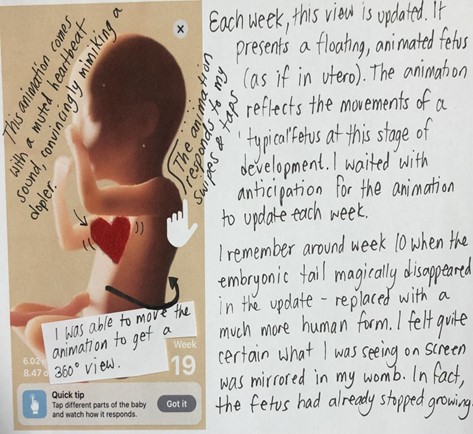
As pregnancy apps shape our imaginations of pregnancy and loss in increasingly sleek and pervasive ways, we emphasise an urgent need for more critical examination of their limitations and potential negative impacts on users’ reproductive journeys. Joining feminist calls to deeply engage technological intimacies we suggest that more democratic and user-centred approaches like app annotations are needed to offer counter narratives of pregnancy and loss. App annotations are one visceral way of intervening into the digital geographies of apps, providing a space to amplify user voices. These annotations can be a method for personal reflection, for sharing more widely to encourage awareness and conversations and – as was the case for us – a tool for building solidarity. By way of example, Carly’s app-annotations were shared with Miscarriage Association, a charity established by and caring for those directly impacted by loss. The charity now features her personal annotations on their website, noting that this resource is vital to opening a wider conversation about apps and how they play an oft overlooked but increasingly powerful role in fertility journeys. Here, these annotations have sparked discussion about how loss is encountered specifically in relation to and through digital spaces. We see this approach as one that might be useful in politicising other app spaces. Specifically, these annotative practices bring into sharper focus how diverse communities encounter overlooked, digital realms. We do not consider this as a tool to simply ‘tweak’ app design, but to fundamentally undermine designer permission and thus control, empowering people to reclaim their own digital spaces and stories.
About the authors: Carly Bagelman is a Senior Lecturer in Education at Liverpool Hope University and Co-Director of the Center for Education and Policy Analysis. Jen Bagelman is a Professor in Geography at Newcastle University and Deputy Director of the Institute for Social Science.
Suggested Further Reading:
Bagelman, C. & Bagelman, J. (2024) Digital geographies of miscarriage: A ‘sister-ethnographic’ approach to pregnancy apps and loss. Transactions of the Institute of British Geographers. Available from: https://doi.org/10.1111/tran.12683
Clark-Parsons, R. (2017). Feminist ephemera in a digital world: Theorizing zines as networked Feminist practice. Communication, Culture & Critique, 10(4), 557-573. Available from: https://doi.org/10.1111/cccr.12172
Healy, R. L. (2021). Zuckerberg, get out of my uterus! An examination of fertility apps, data-sharing and remaking the female body. Journal of Gender Studies, 30(4), 406-416. Available from:https://doi.org/10.1080/09589236.2020.1845628
Hamper, J., & Nash, C. (2021). Bonding work: Spacing relations through pregnancy apps. Transactions of the Institute of British Geographers, 46(3), 584-597. Available from: https://doi.org/10.1111/tran.12446
McNiven, A. (2016). Pregnancy loss, skin-based body modifications and agency. Women: A Cultural Review, 27(2), 202-219. Available from: https://doi.org/10.1080/09574042.2016.1227152
Scuro, J. (2017). The pregnancy [does-not-equal] childbearing project: A phenomenology of miscarriage. London: Rowman & Littlefield. Available from: https://doi.org/10.1017/s2753906700002643
How to Cite
Bagelman, C. & Bagelman, J. (2024, 9 April) Pregnancy apps and the silencing of loss. Geography Directions. https://doi.org/10.55203/JLSR4800
 Geography Directions